
By Pan Xutao
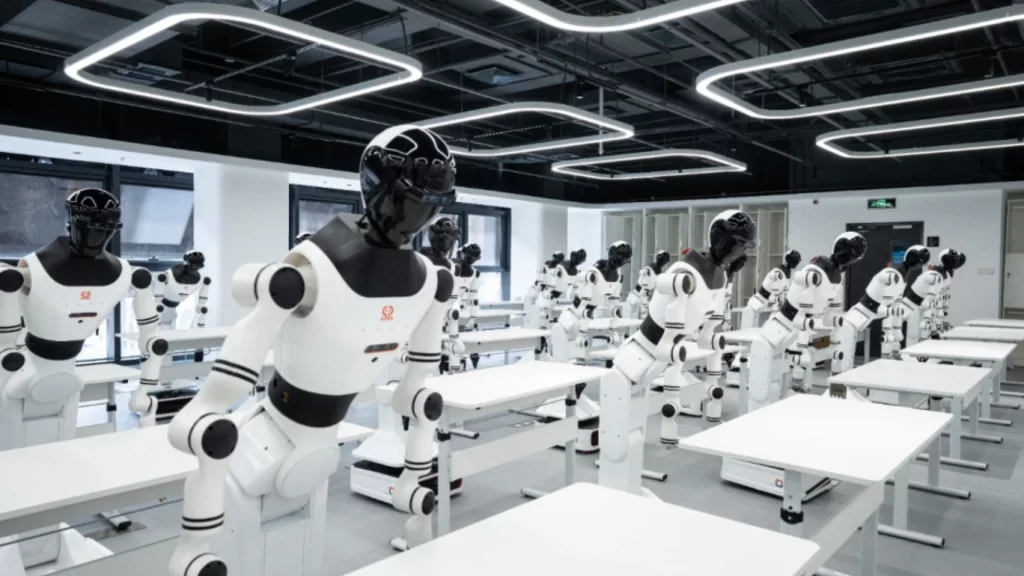
As humanoid robots become increasingly integrated into everyday life, their development now includes a critical educational phase: training. In Beijing’s Shijingshan district, the Phase II Beijing Humanoid Robot Data Training Center—the largest facility of its kind in China—functions as a “school” where robots undergo scenario-based learning before deployment.
Spanning two floors, the center replicates real-world production and living environments at full scale, ranging from coil sorting and parcel packing to cooking and bedroom organization. Each training module, or “cell,” is modular and frequently reconfigured to reflect diverse operational contexts.
The primary model under training is “Kuafu,” a 1.66-meter-tall humanoid robot. Training is conducted in “small-class” settings, with each robot assigned two human trainers. “Just as children require repeated practice to walk, robots must train extensively across diverse scenarios to build functional intelligence,” said Zhu Kai, head of the training center.
He explained that the center addresses a key bottleneck in the robotics industry: the lack of high-quality, structured data. Scenario-based training generates data that are systematically cleaned, labeled, and supplied to enterprises for large-model development.
Zhu said that training was previously conducted independently by individual companies, which led to inconsistent and often low-quality data. In contrast, centralized, standardized data production enables the creation of high-quality, cost-effective datasets that benefit the entire industry. According to estimates, the training center can generate several million high-quality data entries each year.
In one of the data collection zones, trainers Shi Xuanyu and Han Weiqi collaborated to teach a robot the task of “protective packaging. Wearing a virtual reality (VR) headset and using handheld controllers, Han remotely guided the robot while Shi monitored and recorded data from a computer terminal.
At the training center, robots begin by selecting a “major” from four major categories, including industrial manufacturing, smart home applications, elderly care services, and 5G-integrated scenarios. Shi and Han typically require seven or eight days to guide a robot through a single scenario. For example, teaching a robot to place a frying pan on a stove involved 1,250 repetitions to improve the robot’s coordination.
So far, robots trained at the center have acquired more than 20 operational skills, including material handling, inspection, and delivery, with task success rates exceeding 95 percent.
An electronic display at the training center highlights the deployment of several “outstanding graduates. Some work as material handlers at factories of Chinese automaker China FAW Group Co., Ltd., couriers at Shenzhen Capital Group, power inspection officers at China Southern Power Grid Co., Ltd., or service guides at the Zhongguancun Forum.
Environments replicated at the facility mirror real-world operations from companies like ZTE, FAW Group, SF Express, and Unilever. As the industry enters a phase of rapid development, increasing numbers of robots trained at the center are expected to enter homes and industries nationwide.
Source: People’s Daily