
By Mr. Li Xuda
China Soong Ching Ling Foundation, in collaboration with overseas Chinese cultural centers, overseas China national tourist offices and China Soong Ching Ling Science and Culture Center for Young People, hosted the“Junior Cultural Ambassadors” Event this June, 8 Chinese high school students and over 40 foreign students from around the world were awarded the 2025 “Junior Cultural Ambassador”. Ms. Zhao Ruolin, a high school student from Beijing, had the honor to be one of those 8 Chinese awardees.
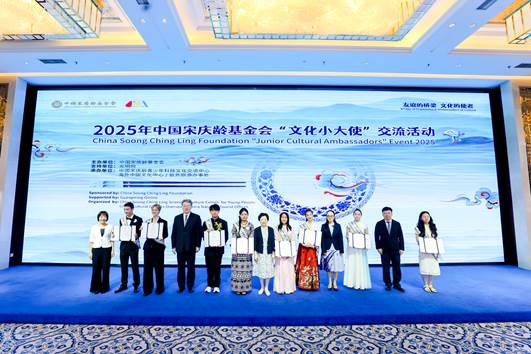
Group Photo of Officials and Awardees (Zhao Ruolin on the far right)
To better play the role of “Junior Cultural Ambassador”, further promote international cultural and educational exchanges, Ms. Zhao Ruolin, conducted an in-depth Interview via Tencent Meeting on Nov 14 with Mr. Yakubu Irabhim, a well-known Nigerian education officer and the founder of “Chinese Corner” in Abuja, Nigeria. Mr. Yakubu has been working in the Federal Capital Territory Secondary Education Board (FCT SEB) of Nigeria more than 30 years,and has made outstanding contributions to strengthening cultural and educational exchanges and cooperation between China and Nigeria.
The following are the main contents of this profound interview focusing on “Achievements and Future Development of China-Nigeria Exchanges”.
Section 1: The development and unique role of the Chinese Corners
Ms. Zhao: From what I know, as an officer of FCT SEB, you have been constantly striving and working hard to promote the construction of Chinese Corner over the years. May I ask how many Chinese Corners have been built in Abuja so far? What role do these Chinese Corners play in the educational and cultural exchanges between China and Nigeria?
Mr. Yakubu: This cultural exchange initiative began lots of years ago. The first Chinese Corner was established at the Universal Basic Education Board in 2007, serving as important platforms for China-Nigeria educational and cultural exchanges.
We established the second one at the Secondary Education Board in 2011, expanded to 11 by 2014, reached 13 in 2024, added two more this year, bringing the total to 15.
These Chinese Corners not only teach Chinese language but also organize a variety of cultural activities: Chinese dance competitions, Nigerian cultural festivals, China-Nigeria cultural carnivals, painting competitions, and more. What impressed me most was that Nigerian teachers and students have also learned lion dance performances, and some teachers even went to China specifically to study Kung Fu, returning to form student Kung Fu teams.
Section 2: Educational Equity and Cultural Heritage: FCT SEB’s Dual Mission
Ms. Zhao: “Could you elaborate on FCT SEB’s primary objectives in secondary education? Your official website highlights ‘ensuring equitable access to quality education’ and ‘preserving Nigerian cultural heritage’. How are these goals implemented on the ground, especially for teenagers?”
Mr. Yakubu: The goal of any educational policy is to provide literacy, which is the most basic requirement, but secondary education should also cultivate students’ critical thinking abilities. In terms of cultural heritage preservation, FCT SEB promotes cultural development through various means such as language learning and cultural activities. We participate in China’s Spring Festival celebrations every year, allowing students to experience Chinese culture firsthand. These activities not only enhance cultural understanding but also cultivate students’ international perspectives.
Section 3: Youth Development: From Policy Analysis to Practical Action
Ms. Zhao: Would you please tell us your insights about effective youth development requirements?
Mr. Yakubu: It’s my pleasure to share my ideas on sociological research. I strongly believe that effective youth development requires several key steps:
1. In-depth Research and Policy Analysis
First, we need to understand what today’s youth truly need to advance their lives. Every society has its unique problems, and we must conduct in-depth research on the society itself and related policies.
2. Advocacy and Promotion
After understanding youth needs, we need to carry out advocacy activities to make the government, people, and youth themselves aware of these needs. Times are changing, youth’s attitudes and demands are also changing; we must keep pace with the times.
3. Resource Mobilization
No policy can be successfully implemented without financial support, this is especially crucial for areas that are geographically remote and economically disadvantaged.
4. Capacity Building
This includes youth skills training and community leader capacity enhancement, enabling them to become self-reliant and contribute to society.
5. Volunteer Service
Encouraging knowledgeable individuals, whether university graduates or outstanding high school students, to conduct volunteer teaching activities in communities.
Section 4: Digital Technology: A New Path to Bridging Educational Gaps
Ms. Zhao: The theme of the 2024 International Youth Day is “Youth Digital Pathways for Sustainable Development. How about Nigeria’s exploration in digital education.
Mr. Yakubu: As early as 2006, we established a smart school in Jabi where students used tablets for classes, teachers sent lectures and assignments through online platforms. So many years passed, now we can say that we have initially achieved digital teaching in some schools.
Today most Nigerian youth own Android phones, which provides a foundation for promoting online learning platforms. During the COVID-19 pandemic, we encouraged online teaching, making many people realize that education can be conducted online. Virtual mentorship is also an excellent approach, just like how we are communicating through Zoom today.
Closing Section: Message to Chinese Youth:Building a Shared Future
Ms. Zhao: Thank you for your time and your valuable insights. Before we conclude today’s interview, do you have any specific messages for Chinese youth or additional perspectives on education and youth development that you’d like to share?
Mr. Yakubu: I have been working with Chinese people in Nigeria for decades, I love Chinese people! I love China! China is a country we deeply respect, here in Africa, especially in Nigeria, we believe China has developed very well. Chinese youth need international cooperation and need to expand friendships, which can be easily achieved through cultural exchanges.
I suggest that Chinese schools could also establish cultural exchange platforms similar to “Chinese Corner”, allowing Chinese youth to learn foreign languages and cultures. Language is a powerful tool for cultural exchange, it can bring people closer and make people feel like brothers.
Here I emphasize the concept of a “global curriculum”: Schools in China and Nigeria can have some similarities in their curriculum regarding cultural exchange, friendship, technological exchange, etc. Schools can carry out joint projects, even starting online, such as researching how agricultural drones can help address drought and other issues together. This kind of curriculum will promote cooperation between the two peoples in education, and these young people will grow up as friends because they share common ideas that will propel us toward prosperity. Just as Chinese policy often states, this is a win-win cooperation for a shared future.
Finally, I want to say that China has always supported Nigeria during difficult times; for example, several years ago China donated medical materials, which was very helpful for us to fight against COVID-19. A friend in need is a friend indeed. China-Nigeria friendship has a long history, cultural and educational exchange is an important bond for maintaining and developing this friendship.
(Photos by Zhao Haijing)
Niger Delta Investment Drive Aims to Benefit From China’s New Zero-Tariffs for African Goods -Edebiri