
By Song Fei
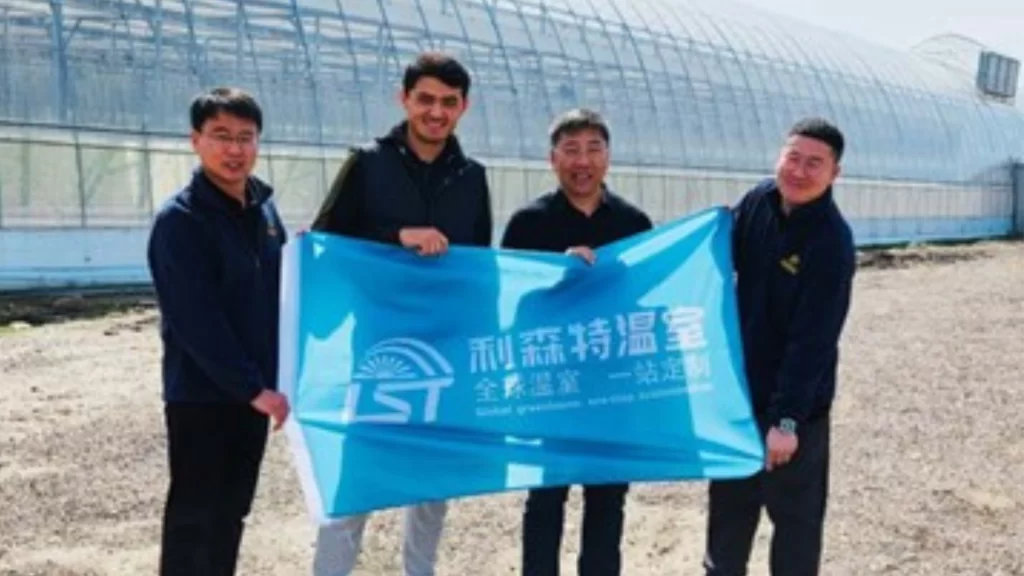
In Shouguang, a major vegetable production base in East China’s Shandong Province, Shandong Lisente Agricultural Technology Co., Ltd. (Lisente) was busy ramping up production to fulfill its orders.
Outside the company’s workshop, a line of container trucks loaded with greenhouse materials was ready to depart. Inside, intelligent robotic arms were swinging into action, welding silver-white galvanized steel into standardized components.
“These materials will be shipped abroad in just a few days. We must keep the margin of error within millimeters,” said Wang Shoubo, chairman of the company.
Under Wang’s guidance for the past 15 years, Lisente has expanded greenhouse technologies in Shouguang to 29 countries and established 262 agricultural parks worldwide. “We provide full-chain services for our international clients, including site selection, greenhouse construction, planting, sales, and training,” Wang explained.
In the company’s materials laboratory, engineers were performing weather resistance tests on newly developed nano-coated films. “This material can withstand extremely high temperatures and last three times longer than standard films. It will be exported to Saudi Arabia,” Wang said.
Stepping out of the lab, he picked up an arched steel beam. “This beam can enhance wind resistance to Level 12, making it very popular in wind-prone Central Asian countries,” he said.
Besides greenhouse infrastructure, the company also delivers technologies and agricultural expertise to other countries. At its test fields, there are 20 miniature greenhouses capable of simulating different geographical conditions, such as the deserts in Dubai, snowy plains in Russia, and arid land in Africa. “Every project should be tested here before going global,” Wang noted.
He pointed to a sensor overhead within a greenhouse. “This sensor is equipped with an Internet of Things (IoT) system developed by our company, which can monitor 50 environmental parameters in real time and has significantly enhanced our crop yields. We also provide instructional videos for every stage of cultivation, from land preparation to harvest. Our clients can easily access them by scanning a QR code,” said Wang.
The greenhouse infrastructure and technologies in Shouguang are gaining international recognition. The integrated water and fertilizer system developed by Lisente has been adopted along the Syr Darya River in Uzbekistan, boosting tomato yields sixfold. In Saudi Arabia’s futuristic city, NEOM, Lisente’s intelligent glass greenhouses now supply 90 percent of organic vegetables for the region.
“In 2025, we plan to establish a shared agricultural technology center in Southeast Asia and build agriculture cooperation centers in Belt and Road partner countries to disseminate our planting techniques to more farmers around the world,” Wang said.
Source: People’s Daily

Niger Delta Investment Drive Aims to Benefit From China’s New Zero-Tariffs for African Goods -Edebiri