
By Xiao Jiaxin and Wang Zhe
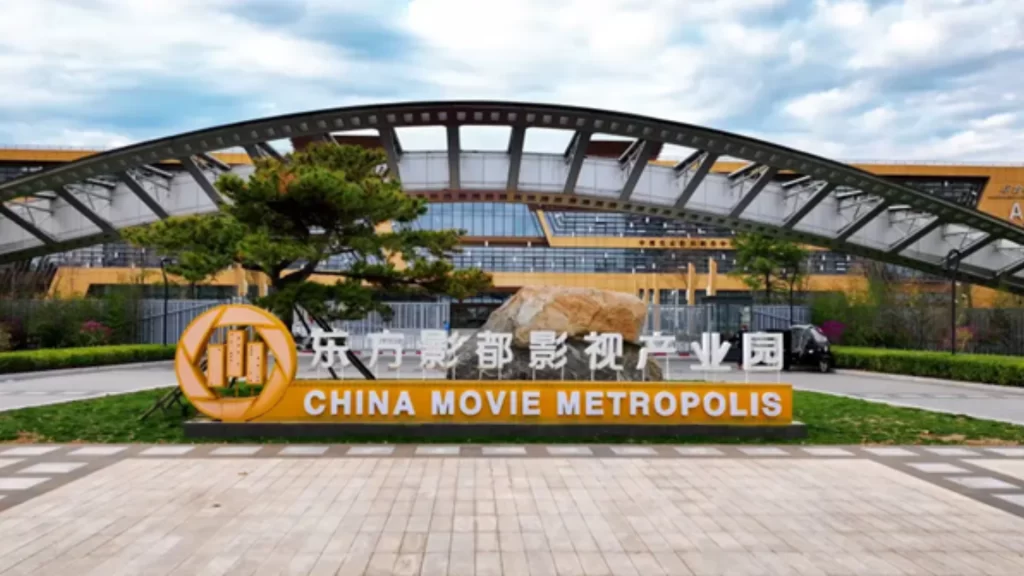
Inside a Soundstage of the China Movie Metropolis (CMM) in Qingdao West Coast New Area, Qingdao, east China’s Shandong province, production of the Chinese sci-fi blockbuster “The Wandering Earth III” is in full swing.
Performers in motion-capture suits move swiftly across the floor, while more than 100 infrared cameras capture every movement. On nearby monitors, digital characters and real-time-rendered environments seamlessly merge, blending the actors with their virtual world.
Several Chinese blockbusters, including “The Wandering Earth,” “Creation of the Gods” trilogy, and “Homecoming, were all filmed or produced at the CMM. The facility is equipped with cutting-edge, industrial-grade equipment, enabling the entire filmmaking process, from script pre-visualization to filming and post-production, to be completed entirely without the studio.
Covering 1.7 million square meters, the CMM boasts 40 international-standard soundstages and 32 set-construction workshops, with its facilities and soundstage sizes meeting leading global benchmarks.
In 2020, the CMM launched its virtual production platform in Soundstage No. 5, a 2,000-square-meter studio. The platform integrates seven advanced technology modules, including motion capture, 3D scanning, and real-time rendering, making it one of the most technologically sophisticated virtual production soundstages in China.
The motion-capture system, featuring more than 100 specialized cameras, is widely used in virtual cinematography for films and TV dramas. “It has cut post-production time by nearly 40 percent and significantly enhanced the efficiency of shooting space scenes,” said Guo Fan, director of “The Wandering Earth” franchise.
The system also allows actors to see virtual environments during their performance, leading to more authentic acting.
The virtual production platform is further enhanced by an ultra-high-precision facial scanning system, which improves the accuracy and efficiency of digital-human modeling, providing exceptional realism in character rendering.
Strategic spatial planning across the complex ensures smooth transitions between sets. “Our soundstages and set-construction workshops are strategically paired in clusters,” explained Yu Qiubei, technical director of the CMM. “This 1:1 layout minimizes communication barriers that often arise when filming locations and set-building areas are too far apart.
Another signature feature of the CMM is its world-class underwater production center, which includes a state-of-the-art indoor heated water-tank stage, a large outdoor shooting pool, and professional blue screens. The 1,300-cubic-meter tank, maintained at a constant 32 degrees Celsius, allows actors to move with greater flexibility underwater, making it ideal for a wide range of filming needs. Movies such as “A Writer’s Odyssey” and “Operation Hadal” have used this facility for their underwater scenes.
Thanks to the CMM, Qingdao has developed a comprehensive film industry complex, with a total built-up area of 5.4 million square meters. The ecosystem is now home to nearly 1,200 film-related companies and has supported more than 700 film and TV projects, variety programs, and large-scale events, contributing over 10 billion yuan ($1.42 billion) in film-related output.
In one special-effects studio, a bionic mechanical dog moves at the touch of a remote, its mouth opening and eyebrows furrowing. To create realistic on-screen animals, the studio crafted the robotic dog from flexible silicone and outfitted it with advanced control systems, explained studio general manager Wang Ke. After hundreds of adjustments, the team achieved the desired lifelike performance.
The studio is also home to computer numerical control machines, 3D printers, and laser engravers, used for designing and producing special props for major films. Wang relocated his studio from Beijing to Qingdao in 2022, attracted by the powerful cluster effect of the CMM. “The CMM draws in teams working on science-fiction and fantasy projects,” he explained. “Our studio specializes in mecha and bionic mechanical props, and the items we produce are easily integrated into the soundstages next door.
Today, Qingdao West Coast New Area hosts more than 1,000 companies in the film and cultural sectors, covering the entire film production process, from creation to post-production. The thriving ecosystem of the CMM is not only propelling the growth of China’s film industry but also positioning Qingdao as a hub for film production and innovation.
Source: People’s Daily
Niger Delta Investment Drive Aims to Benefit From China’s New Zero-Tariffs for African Goods -Edebiri