
By Li Maoying
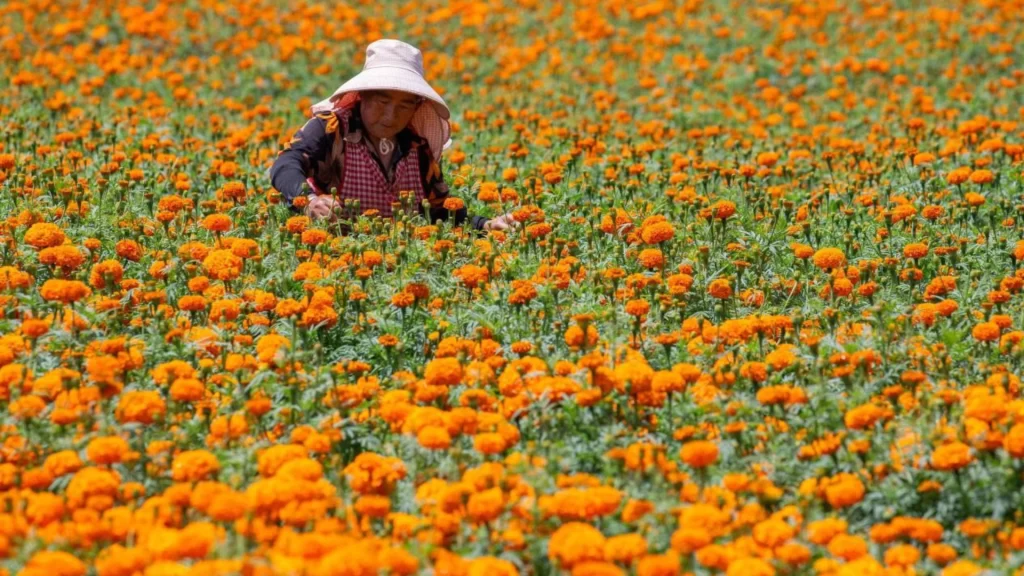
By leveraging its unique natural endowments and strengthening innovation across the entire industrial chain, Yunnan province in southwest China is transforming its floral industry into a pillar of high-quality development. It not only showcases beauty but also delivers tangible gains for people’s livelihoods.
At dawn, flower growers are already busy harvesting at a flower base in Jinning district, Kunming, the capital of Yunnan province. Roses still glistening with morning dew are clipped one after another and sent to sorting centers.
After being automatically graded and packaged by intelligent equipment, where do these flowers go? The answer lies at the Kunming International Flora Auction Trading Center. At this trading center, a deal is closed on average every four seconds. Whether operating under a “sell first, harvest later” or “harvest first, sell later” model, about seven out of every 10 cut flowers sold in China come from Yunnan.
This success could not have been achieved without a complete industrial chain spanning seed breeding, research and development, technology-enabled cultivation, and efficient market circulation. Innovation in seed breeding provides a critical foundation for the upgrading of the floral industry. For a long time, many flower growers complained that “every flower sold meant paying hefty patent fees.
In May 2025, more than 1,000 domestically bred China rose varieties for cut flowers were unveiled in Kunming. In recent years, Yunnan has followed a differentiated development path rooted in local resources, steadily bringing homegrown flower varieties to market and achieving a breakthrough with independently bred, high-altitude-adapted varieties.
The integration of this “Chinese core” into the flower industry addresses long-standing challenges, including overreliance on imported primary varieties and underdeveloped green production technologies. By eliminating external dependencies, growers keep more of the value they create, giving distinctive local industries greater momentum to move up the value chain.
Traditional agriculture remained vulnerable to climatic shifts, where a single late spring cold snap could cause heavy losses. Today, empowered by technology, flowers enjoy tailor-made growing environments and nutrient solutions.
In the intelligent greenhouses of a modern flower base in Lijiang, Yunnan province, an automated environmental control system precisely regulates temperature and humidity, while integrated water and fertilizer pipelines deliver nutrients directly to plant roots. Soilless cultivation has replaced backbreaking fieldwork; one can walk through the greenhouse without muddying a single shoe.
With better growing conditions come higher quality, greater yields, and stronger resilience. When technological innovation drives industrial upgrading, agriculture gains powerful wings for modernization.
For local resident He Guozhen, the flower industry has brought jobs to her doorstep. After transferring her land to the Lijiang Modern Flower Industrial Park, three members of her family found stable employment there, together earning more than 100,000 yuan ($14,202) annually.
He’s story is emblematic. In 2024, Yunnan produced 20.6 billion stems of cut flowers, directly employing 380,000 people and indirectly supporting over 1 million. Across cultivation, processing, and distribution, countless households are sharing in the dividends of development and achieving higher incomes.
Yunnan now boasts a wide range of specialty products—from flowers to coffee and tea—which form a solid industrial foundation for advancing all-around rural revitalization. By strengthening seed innovation at the source, improving quality and efficiency through technology-driven cultivation, and refining mechanisms that link farmers more closely with industrial development, Yunnan continues to extend industrial chains and increase added value.
As these “beautiful industries” gain depth and resilience, a development path that promotes both ecological conservation and shared prosperity, while advancing urban-rural integration, is steadily taking shape.
Source: People’s Daily



Shaping Multipolar Order: SCO Expands Strategic Role on 25th Anniversary