By Luo Shanshan and Xu Jing
Homestays are increasingly integrated into China’s rural tourism and cultural industries, with Huangshan in East China’s Anhui province as a pioneering model. By embedding homestays within village ecosystems rather than operating them as standalone businesses, the city has transformed these accommodations into vibrant sources of rural revitalization.
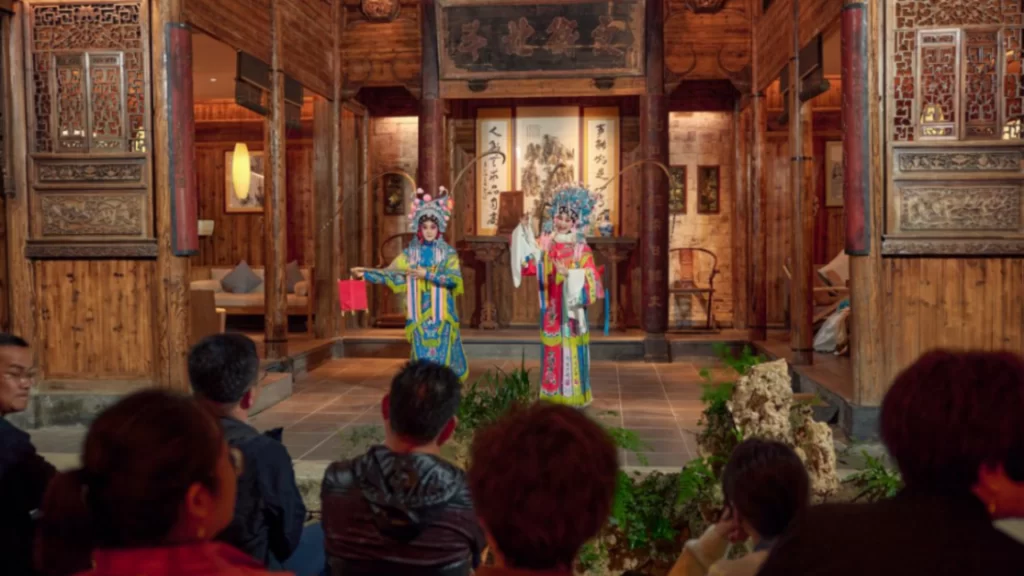
At 7:30 p.m., drumbeats signaled the start of an evening gala at the activity center of Shiting village in Yixian County, Huangshan. Visitors from Shanghai and local villagers took turns performing, creating a lively and convivial atmosphere.
“These Shanghai visitors share a passion for singing, and the villagers regularly stage performances. Bringing them together was a natural fit,” explained Huang Zhiyong, founder of the Shiting Huayi homestay and initiator of the event.
For Shanghai visitor Ling Ling, this marked her third stay at the homestay within three months. “I’m drawn to this place,” she said. “I want to immerse myself more deeply in the experience.
Yixian County hosts 46 nationally recognized traditional villages, including UNESCO World Heritage sites Xidi and Hongcun. Often described as a “living landscape painting,” the area is one of the birthplaces of Huizhou culture and is renowned for its well-preserved Ming Dynasty (1368–1644) and Qing Dynasty (1644–1911) architecture, as well as its distinctive blend of natural and cultural heritage.
After years of working away from home, Huang returned to Yixian in 2012 with plans to open a homestay. He was immediately captivated by a traditional Huizhou-style courtyard in Shiting Village during his location scouting.
“Huizhou culture is richly multidimensional—encompassing not just architecture but also opera and craftsmanship,” Huang said. “I envisioned the homestay as a gateway for visitors to experience this cultural beauty. He emphasized that long-term success requires homestays to take root in village life and draw nourishment from local cultural traditions.
In recent years, Chinese consumers have shown growing demand for culturally immersive experiences. This shift has transformed the homestay sector from merely providing accommodation to fulfilling higher expectations for aesthetic appeal, cultural enrichment, and emotional resonance.
Huangshan now hosts over 3,200 homestays across more than a dozen distinctive clusters. “Avoiding homogenization and offering differentiated products and services” has become a shared understanding among many local homestay operators.
A prime example is Yunshang Homestay in Huangshan’s Tangkou Township, nestled within a bamboo-forested valley. Owner Cheng Xinfeng, a travel and culinary enthusiast, explains: “We position ourselves as a boutique retreat focused on comfortable spaces and healthy food. She maintains an on-site garden for vegetables, poultry, and fish, while seasonally sourcing tea, honey, and dried bamboo shoots from nearby villagers. “These are products I genuinely like and feel confident sharing with guests,” Cheng said, adding that many guests would continue ordering local produce from her online.
Sun Min, an ’80s-born entrepreneur who returned to his hometown, targets travelers aged 18–40 at his Wujiujiu Cultural and Creative Homestay within Yixian County’s Tachuan National Forest Park. Capitalizing on younger travelers’ desire for photogenic experiences, the property features views of rice fields and Chinese tallow trees. “I want every guest to capture photos they truly cherish,” Sun emphasizes.
Alina Garden Homestay in Huangshan is jointly run by a cross-cultural couple: Huang Qiong from Shenzhen and her husband, born in Australia. “With the expansion of visa-free entry policies, we’ve seen more international visitors over the past two years, and that’s an opportunity for us,” Huang said. “We hope to serve as a bridge for foreign guests to better understand Huangshan”.
The homestay now specializes in Huangshan hiking and tai chi sessions, with guests invited to participate daily. “International visitors are genuinely interested in Chinese culture,” Huang said. “They want to participate, not just admire the scenery from a distance.
“Many of Huangshan’s homestays are located in rural areas, and they have become a key driver of comprehensive rural revitalization,” said Wang Weizhi, an official with the rural tourism division of the Huangshan municipal bureau of culture and tourism. To support operators, the city introduced a dedicated regulation on the promotion and management of homestays last year. The regulation clarifies policies on land use, financial support, and licensing, giving operators greater certainty and confidence.
Compared with hotels, homestays are small in size, but they still need to come with front-desk services, housekeeping, catering, and, in many cases, customized cultural and recreational activities—all of which depend on skilled professionals.
To address this need, local authorities have offered support for Huangshan University and Huangshan Vocational Technical College in establishing programs dedicated to homestay management and operations. The city has also organized training courses for homestay managers at both the municipal and county levels. To date, 335 participants have obtained nationally recognized vocational skill certificates.
Xiao Hongxia, secretary-general of the Huizhou homestay association in Huangshan, believes the next step is to foster integrated ecosystems centered on the homestay business. “If operators can work together, share resources, and build ecosystems, the entire sector will become healthier and more sustainable,” she said.
Source People’s Daily