
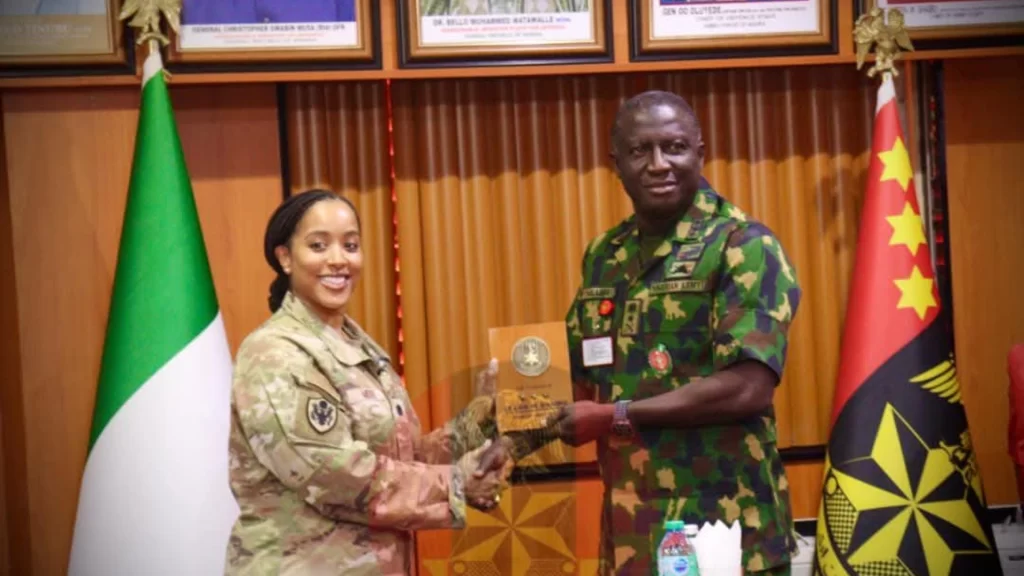
U.S. Representative and the Nigerian COAS Synchronize Operations, Shifting from Traditional Assistance to Deep Strategic Integration.
The U.S. Military shipment that arrived quietly in Abuja on January 13 was never intended to speak for itself. Its importance lies less in the crates offloaded than in the events that led to their arrival, and in how little both sides are saying about what comes next.
When U.S. Africa Command confirmed that “critical military materiel” had been handed over to Nigerian partners, the statement was striking for what it left out. No list of equipment, valuation, or indication of whether this was a one-off delivery or the start of something more sustained. Defence sources in Abuja say the transfer bypassed routine procurement channels and was instead handled through an operational framework tied to ongoing joint planning. One official described it as “mission-tied, not warehouse stock.”
That distinction matters. This shipment did not emerge in isolation. It was followed by barely three weeks, a rare U.S. airstrike carried out on Christmas Day in Sokoto State. The strike targeted Islamist militants linked to the Islamic State network operating along Nigeria’s north-western corridor. Officials familiar with the operation say Tomahawk missiles were launched from a U.S. naval platform in the Gulf of Guinea, with targeting coordinated through Nigerian intelligence.
What stood out was not only the use of U.S. firepower, but also the openness surrounding it. Nigerian authorities publicly acknowledged that the strike was conducted in coordination with U.S. forces—an unusually direct admission in a relationship long defined by careful ambiguity. In doing so, Nigeria crossed a new threshold: accepting U.S. kinetic action on Nigerian soil as part of a broader counter-terrorism effort.
Since then, there has been a shift in the tone of bothsides. The U.S. officials are no longer speaking primarily in terms of advisory support, and Nigerian counterparts are no longer treating cooperation as occasional or transactional. Several security officials describe the current phase as one of “post-strike integration,” focused on aligning communications, surveillance, and logistics to sustain operational momentum rather than simply build capacity.
A senior Nigerian security official, speaking privately, put it more bluntly: “This is no longer assistance. It is synchronisation.” The distinction is not academic. Assistance can be paused, renegotiated, or declined. Synchronisation implies shared timelines and compressed decision-making. Once it begins, stepping back becomes far more complicated.
Seen in that light, the January shipment makes sense. Analysts believe it is intended to consolidate the gains of the Sokoto strike by replenishing systems used in the operation, improving real-time coordination, or enabling follow-on actions. Whatever its exact contents, the delivery signals that Washington is prepared to remain engaged beyond a single, symbolic show of force.
Which raises the obvious question: why now?
Part of the answer lies beyond Nigeria’s borders. As Mali, Burkina Faso, and Niger consolidate under the Alliance of Sahel States and push Western militaries out, the United States is recalibrating its regional posture. Coastal and anchor states have become essential for containing militant spillover toward the Gulf of Guinea and preserving intelligence reach in an increasingly constrained environment.
Nigeria sits at the centre of that recalibration, not just as a theatre of operations, but as a strategic platform.
At the same time, Washington’s political messaging has grown sharper. President Donald Trump’s repeated public description of violence against Christians in Nigeria as “genocide” has drawn strong objections from Nigeria, which views the framing as both inaccurate and diplomatically damaging. Many diplomats view the rhetoric less as moral outrage than as leverage: language that keeps political pressure available even as military cooperation deepens.




Shaping Multipolar Order: SCO Expands Strategic Role on 25th Anniversary