
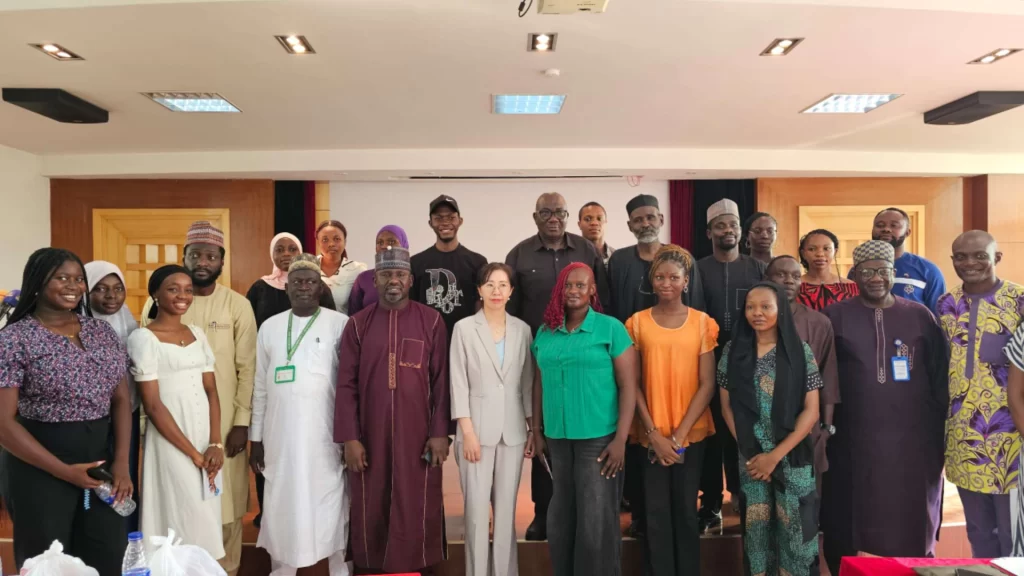
Scholars and diplomats from Nigeria and China have called for a deeper understanding of the One-China Principle, describing it as the foundation for stable diplomatic and economic relations between the two countries.
The call was made on Thursday, May 14, 2026, at a Media Salon organized by the Centre for China Studies and the Centre for Contemporary China-Africa Research. The event, held at the China General Chambers of Commerce in Abuja, was themed “Understanding the One-China Principle and Its Role in Deepening China-Nigeria Strategic Relations.”
Delivering the opening remarks, Dong Hairong, Counsellor at the Embassy of the People’s Republic of China in Nigeria, stated that Taiwan has been an inalienable part of China’s territory since ancient times.
‘’Taiwan has belonged to China since time immemorial, with clear historical context and a solid legal basis. A wealth of historical records and documents chronicle the early development of Taiwan by the Chinese people. As early as the 12th century, the Chinese government set up administrative institutions in Taiwan and exercised jurisdiction over the region,’’ she said.
The Counsellor also noted that after Taiwan was seized by Japan in 1895, the United States and Britain, at the end of World War II, issued a declaration that Taiwan be returned to China.
In 1943, toward the end of World War II, China, the United States, and Britain issued the Cairo Declaration, stipulating that Taiwan, stolen by Japan, should be returned to China. In 1945, China, the United States, Britain, and the Soviet Union released the Potsdam Proclamation, which affirmed that the provisions of the Cairo Declaration must be implemented. And in August the same year, Japan accepted the Potsdam Proclamation, and signed the Instrument of Surrender the following month, undertaking to faithfully fulfil all provisions of the Potsdam Proclamation,’’ the Counsellor declared.
Further, she highlighted that in October 1971, the 26th session of the United Nations General Assembly adopted Resolution 2758, which explicitly established politically, legally, and procedurally that there is only one seat for China in the United Nations, leaving no room for ‘’two Chinas’’ or ‘’one China, one Taiwan’’.
‘’As such, resolving the Taiwan question and realizing complete national reunification is the shared aspiration of all Chinese people and an inherent part of the great rejuvenation of the Chinese nation. And since the establishment of diplomatic ties between China and Nigeria in 1971, Nigeria has made solemn commitments to upholding the One-China Principle and opposing Taiwan independence on multiple occasions in the joint communique on diplomatic establishment and bilateral joint statements.’’
‘’China sincerely expects all sectors of Nigerian society, including Nigerian journalists, to always abide by the One-China Principle and resolutely uphold China’s core interests and territorial integrity,’’ she concluded.
Prof. Sheriff Ghali Ibrahim, Provost of the Anti-Corruption Academy of Nigeria and Director of the Centre for Contemporary China-Africa Research, spoke on “One-China Principle as the Bedrock of China’s Diplomatic Relations. He argued that the recent visit to Eswatini by Taiwanese leader Lai Ching-te was trepidatory in nature, abnormal in diplomatic practice, and erratic in international relations.
‘’Lai Ching-te’s visit has been described as a theft-like visit, primarily due to its secretive nature. It is an aberration to the peace of Westphalia, which established international relations and diplomatic engagement between and among sovereign states,’’ he said.
Professor Ghali also noted that the One China Policy has been enshrined in the deep-rooted foundation of China-Africa cooperation, which defines trust, respect, and a shared future for the two partners.
‘’Contained in the Beijing Declaration of the 2024 Forum on China-Africa cooperation, is the African leaders’ commitment to the “One-China Principle.” In his annual visit to Africa, Wang Yi was assured continuous adherence to the One-China policy by the African Union.
The unity of Africa is manifest in its reaffirmation of mutual sovereignty and United China. This gives a drastic nod to peaceful reunification and the rejuvenation of the Chinese nation,’’ he stated and continued.
‘’China’s unflinching commitment to the One-China Principle remains a cornerstone of its foreign policy; it is a core national value attached to the issue of sovereignty of the People’s Republic of China. This stance continues to receive broad support from the international community, including the majority of African nations. The principle, which asserts that there is only one China and that Taiwan is an inalienable part of it, has long been recognized by the United Nations and forms the political foundation for China’s diplomatic relations with other countries,’’ he said.
In a similar paper presented, ‘’The Role of African Countries in Upholding the One-China Principle,” Prof. Sam Amadi, Director of the Abuja School of Social and Political Thoughts and Dean of the Law Faculty at Ave Maria University, opined that everybody who has been in foreign policy knows that the One-China principle, One-China policy is clear, but difficult to operationalize.
‘’From a diplomatic perspective, it looks the same, but they are not the same. Ben-Gin’s perspective is the One-China principle, which has three things. One, of course, is one-China. Two, that the sovereign authority of that One-China is the CCP, the Chinese Communist Party. Three, that ultimately peaceful reunification of Taiwan, of China, that means Taiwan, the island, and mainland China into one under the legal authority of the CCP. The One-China policy, if you like, is not the Chinese position. It is the position of other sovereign countries that say and acknowledge the Republic of China’s claim about one policy. They accept, but they do not necessarily endorse it. But they acknowledge and try to keep it. They also agree that the CCP is the authority, but they recognise the de facto policy or the de facto ground that is Taiwan, that a democratic Taiwan operates a different system. And so, the problem has always been, how do you acknowledge Ben-Gin’s claim and deal with the real-world situation of engaging with Taiwan? And let’s not forget that the evolution started after the war.”
So, the question is, how should Africa, and particularly Nigeria, deal with this issue? And I want to be very clear about it. The consensus is for the One-China Principle, as you said. But state parties are always ambiguous, what they call strategic ambiguity in diplomacy.
‘’My prescription would be that African countries have a history of keeping territories intact. The premise of the AU is that territories should remain as they are. So, it aligns with the Chinese, with the People’s Republic of China’s position, which is that there is one China. And internal conflicts or internal disagreement in that territory should not be taken to represent separate statehood. The same way we argue about whether it is Biafra or Doha or another formation. But the reality, as we know, in the age of self-determination and self-expression, is much more complex. So, the point, therefore, would be this. I would say one of the things that Taiwan is doing that is bad is what we call sovereignty for rent. You know, you pay, you acknowledge our sovereignty. And that’s probably what Eswatini did, sovereignty for rent. You get paid, you acknowledge. But that is not sustainable in the world. So, for Africa, my position is that, as a foreign policy person, we should never have any diplomatic engagement with Taiwan, but we should calibrate our trade agreement to ensure that it does not contradict the core principle, but at the same time, take cognizance of the elephant in the room,’’ he declared.
The event drew academics, policy analysts, and business leaders from both Nigeria and China, including Mr. Charles Onunaiju, Director of the Nigeria Centre for China Studies; Prof. Sule Magaji of the University of Abuja; Prof. Mukhtar Imam, a foreign policy scholar; and Dr. Bibi Farouk, Associate Professor at the University of Abuja.





Shaping Multipolar Order: SCO Expands Strategic Role on 25th Anniversary