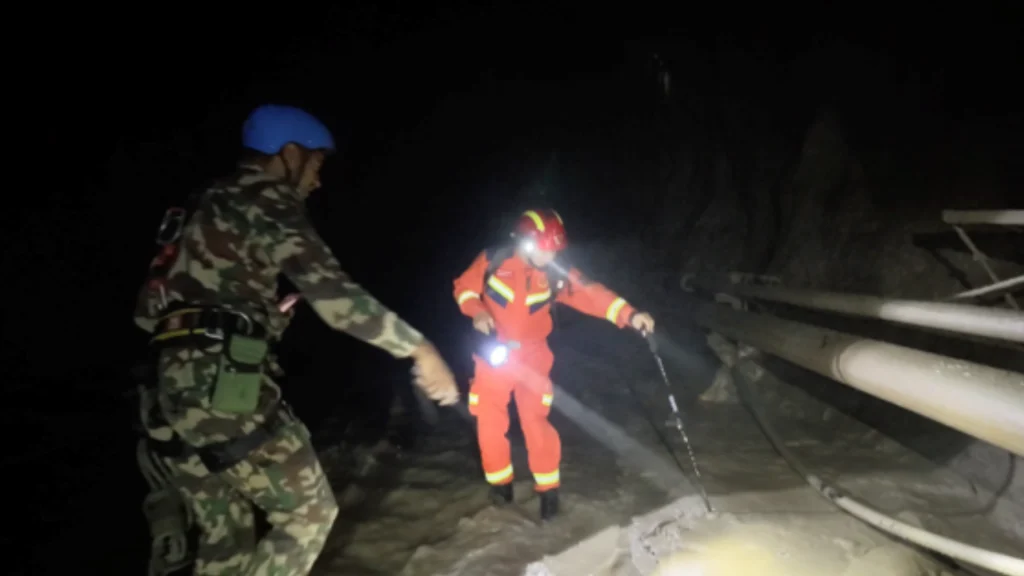
Deep within Sichuan’s mountainous terrain at an elevation of 2,800 meters, an innovative computing center now operates inside tunnels adjacent to a major hydropower dam. This facility repurposed tunnels originally destined for backfilling into a naturally cooled, energy-efficient computing hub.
Operational since December 2025, the Lianghekou Hydropower Plant’s integrated computing project in China’s Garze Tibetan Autonomous Prefecture represents the nation’s first high-altitude, subterranean intelligent computing center. Six mountain-embedded modules house 2,000 domestically produced computing chips, delivering processing power equivalent to 240 million standard office computers.
The tunnel environment provides immediate advantages: a constant 5 degrees Celsius temperature with stable humidity. “This significantly reduces energy consumption,” explains Wang Wensong, executive deputy director of the hydropower plant, gesturing toward rows of blinking servers.
Computing power, often described as the “highway system” of the digital age, is a key pillar of new infrastructure.
Launched in March 2025, the Lianghekou computing project is a joint effort between Yalong River Hydropower Development Co., Ltd. under the State Development and Investment Group Co., Ltd. (SDIC Group), and the Sichuan branch of China Telecom. It explores how computing resources and power generation can be coordinated for greater efficiency.
Why choose this remote location? “Beyond reliable transport and communications, we require exceptional safety and stability,” Wang notes. The deep tunnels leverage the dam’s seismic resilience, high-altitude natural cooling, and abundant low-cost electricity. “Sharing the hydropower station’s security systems creates multiple advantages.”
Energy efficiency is measured by PUE (Power Usage Effectiveness), where lower values indicate better performance. “Our tunnel’s natural cooling maintains PUE below 1.2—among China’s most efficient facilities,” states operations head Liu Yuanshou. The center’s six modules consume approximately 1,400 kWh hourly, equivalent to powering 1,400 air conditioners simultaneously.
The computing center is part of a broader clean energy ecosystem. By the end of 2025, the Suorong solar power station, part of the Lianghekou project cluster, also began operation. Together with the Kela Phase I and Phase II solar plants and the Lianghekou hydropower plant, it forms the world’s largest integrated hydro-solar project, with a total capacity of 3 million kilowatts from hydropower plus 3 million kilowatts from solar power.
With additional support from pumped-storage hydropower, this integrated system ensures a steady, year-round supply of green electricity for the computing center. The Yalong River Hydropower Development Co., Ltd. is now working to build a 10-million-kilowatt-level comprehensive demonstration zone integrating hydropower, wind, solar, energy storage, hydrogen, and computing resources.
The generated computing resources extend beyond the mountains. Transmitted via optical fiber across hundreds of kilometers, it reaches Mount Haizi in Daocheng county, where a major national scientific facility, the Large High Altitude Air Shower Observatory (LHAASO), is located.
“Once the project was completed, we began working with the Chinese Academy of Sciences to provide computing support for LHAASO,” Wang said. “Using AI, we can process particle physics data more efficiently.”
In this way, clean hydropower is transformed into the computational strength needed to explore the origins of cosmic rays, supporting cutting-edge scientific research.
As operations stabilize, the center now develops specialized AI models for weather forecasting and industrial applications. China Telecom utilizes it for internal needs while offering external services via a computing resource platform — serving academic research to smart city initiatives alike.
Yalong River’s flowing waters now power computation driving diverse industries. “We’ll replicate this model using Lianghekou’s tunnel resources,” Wang concludes. “Our mission is to integrate Sichuan’s renewable energy strengths with advanced computing clusters through direct green electricity supply systems.”
By You Yi
Source: People’s Daily