In a rare cultural showcase, the tranquil and soothing notes of the Guqin drifted through Nigeria’s capital on May 20, 2026, as government officials, diplomats, artists, and cultural enthusiasts from both countries gathered for an immersive salon of Chinese intangible heritage.
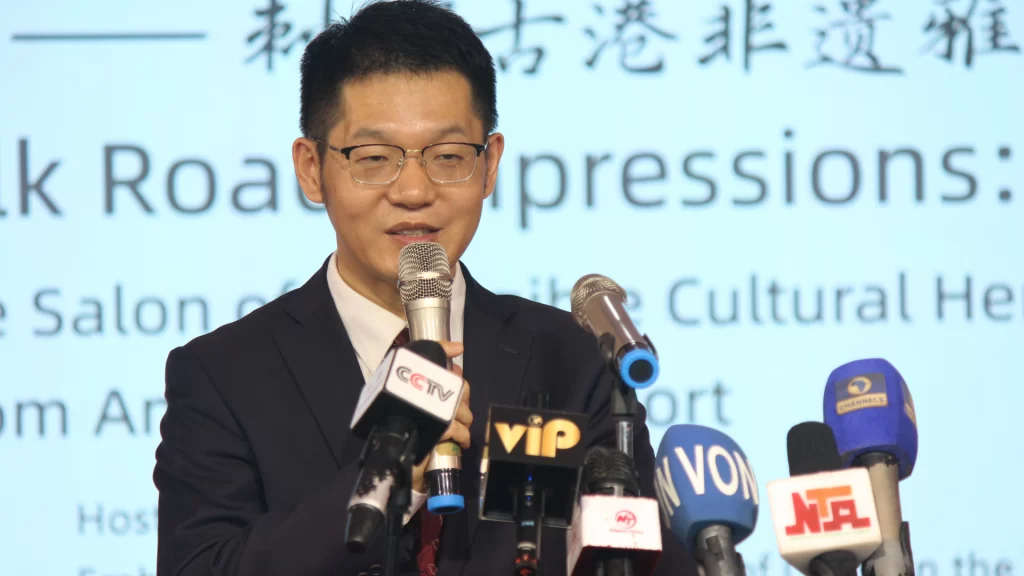
Hosted jointly by the Embassy of the People’s Republic of China in Nigeria, the China Centre for International Cultural Exchange and Tourism Promotion, and the China Cultural Centre in Nigeria, the event titled; ”Maritime Silk Road Impressions: Immersive Tea for Harmony Yaji Cultural Salon of Intangible Cultural Heritage from Ancient Zayton Port,” the event brought together government officials and other dignitaries from both countries to the China Cultural Center in Abuja.
Delivering the welcome message, Mr. Zhou Hongyou, Minister of the Chinese Embassy in Nigeria, said that tea came from China about 5,000 years ago. Later, it travelled to many parts of the world through the Silk Road and the Tea Road.
”Today, we gather here over tea to connect with friends through meaningful conversation, hoping to experience the deep roots of Chinese culture as we enjoy tea and reflect on its meaning, and, in the warmth of its fragrance, to deepen our understanding and friendship with one another,” he said.
Emphasizing the significance of the event, he stated that the ancient Silk Road stretched for thousands of miles, carrying not only spices, silk, porcelain, and the gentle melodies of the guqin, but also a lasting spirit, the spirit of peaceful cooperation, openness, and inclusiveness, mutual learning, and mutual benefit.
”This spirit has been passed down through generations and remains alive today, serving as a powerful driving force for China and Nigeria to jointly implement the Belt and Road Initiative and build a community with a shared future for mankind,” he stated and continued.
”This year marks the 55th anniversary of China-Nigeria diplomatic relations and the China-Africa Year of People-to-People Exchanges. Through culture’s timeless, borderless power, we hope to deepen understanding and friendship between our peoples, to honour the ancient Maritime Silk Road’s role in human exchange, to carry forward the Silk Road spirit, and to build public support for our joint efforts under the Belt and Road Initiative,” Zhou declared.
H.E. Abdulkarim Ozi Ibrahim, Permanent Secretary of the Federal Ministry of Arts, Culture, Tourism and Creative Economy in Nigeria, delivered his goodwill message through his representative, Mr. Yohanna Evandu, Director of International Cultural Relations of the ministry, noting that Nigeria may not have a century of tea tradition like China, but that tea is far more than a beverage in Nigeria.
Though tea is not indigenous to Nigeria, its socio-economic and cultural significance has grown over time. The popularity of tea in Nigerian homes, markets, and corporate spaces speaks to its role as a unifying social lubricant,” he said.
”From the misty hills of Jiangnan, where Longjing tea whispers tales of emperors and poets, to the bustling tea stalls of Lagos and Kano, where Nigerians gather to share stories over steaming cups of Zobo and Sobo-tea, in all its forms, foster connection.”
The Permanent Secretary further reiterated the ministry’s commitment to promoting creative enterprises around tea, supporting tea-related festivals, and enhancing partnerships that improve Nigerian participation in the global tea economy.
”Nigeria and China share a bond that transcends trade and diplomacy-it is a bond woven through mutual respect for heritage, artistry, and the transformative power of culture. As we savour the delicate aroma of Jiangnan’s finest teas today, let us also envision a future where Nigeria and China co-create opportunities in the creative sector,” he said.
The programme also featured a series of live demonstrations and performances that traced China’s artistic and craft traditions. Guests were treated to an intangible cultural heritage performance of Chinese Guqin art, followed by demonstrations of traditional incense sealing, indirect incense burning, and other classical incense ceremony practices.
A performance of a full Gongfu tea brewing offered guests the chance to observe and taste Pu’er tea prepared through the complete tea art procedure. Interactive sessions allowed guests to engage directly with Chinese tea culture, ceramics, incense traditions, and Guqin music.