By Shen Wenmin
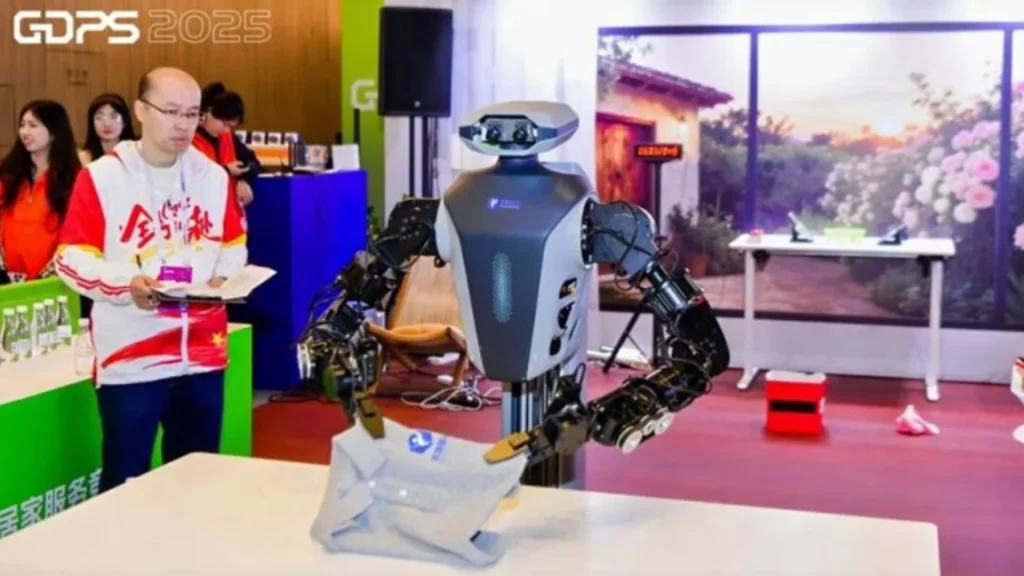
The Global Developer Pioneers Summit 2025 and the International Embodied Intelligence Competition (GDPS 2025) were held in Shanghai from December 12 to 14. This event explored the integration of artificial intelligence, transitioning from theoretical algorithms to tangible, real-world applications.
Embodied intelligence, which is steadily making its way into diverse aspects of human life, was prominently showcased across multiple sectors. With three primary competition tracks—industrial production, daily-life services, and professional services—the event highlighted significant technological advancements and the industrial potential of this field.
Industrial Production: Competing in Millimeters and Milliseconds
At the industrial manufacturing competition, the air was filled with the hum of high-frequency motors. During the industrial assembly challenge, a humanoid robot efficiently completed a precision assembly task. Equipped with high-definition visual sensors, its robotic arm identified three different components in just 0.3 seconds. Its fingertips adjusted gripping force with an accuracy of 0.01 millimeters, completing eight processes—including positioning, insertion, and tightening—with flawless precision.
“By reducing each servo cycle by 0.5 milliseconds, the entire grasping process is accelerated to match human speed,” explained a Generation Z developer who was fine-tuning parameters with their team. The team’s real-time motion control algorithm enabled the robot to achieve significant breakthroughs in both efficiency and precision, despite limited computing resources.
Yao Qizhi, an academician of the Chinese Academy of Sciences, emphasized that for embodied intelligence to advance, it must evolve from isolated skills to full-body coordination. “At present, robots’ mobility and manipulation are managed by two separate systems. The future will demand unified control over whole-body movement and fine motor skills to support complex, multi-step, general-purpose actions,” he explained.
Daily-Life Services: More Personalized Forms
The daily-life services track focused on practical applications in everyday settings. In a simulated community environment, an intelligent service robot assisted elderly participants. Through voice interaction, it identified individual needs and delivered relevant information about community events. When interacting with those with limited mobility, the robot offered a support handrail and guided them gently across ramps, providing reminders to “walk slowly.”
“The robot understands my dialect and responds quickly. Having such a helper in the community would make life much easier,” remarked one elderly participant.
The home services track demonstrated even more personalized solutions. A household service robot autonomously planned its movements to avoid obstacles, identified food items in kitchen cabinets, and reminded users of expiration dates. It also recommended recipes based on health data and flexibly adjusted cleaning modes to avoid areas where infants were crawling.
According to its developer, the robot is powered by a multimodal large model capable of deeply understanding nonverbal human behavior, such as facial expressions and movements, to better understand user needs and deliver personalized services.
Professional Services: A Test of Real-World Capability
The professional services track covered two major scenarios—emergency rescue and medical/elderly care—challenging embodied intelligence in extreme, high-stakes environments.
In the emergency rescue simulation, a disaster site was recreated with collapsed debris blocking roads and thick smoke reducing visibility to less than one meter. Upon activation, a tracked rescue robot rapidly synthesized sensor data to determine the optimal route. It traversed rubble, continuously adjusted its posture to maintain balance, and successfully navigated the obstacles to locate trapped individuals and transmit their vital signs.
The medical and eldercare scenario highlighted the balance between “precision” and “gentleness.” In a rehabilitation setting, a robot assisted a patient with limb exercises. Using force-feedback technology, it dynamically adjusted its assistance based on real-time monitoring of the patient’s exertion, ensuring effective training while minimizing the risk of secondary injury.
Additionally, a surgical-assistance robot demonstrated its capabilities in minimally invasive procedures. With its mechanical arm, the robot performed precise cuts and sutures on simulated human tissue, maintaining an error margin of just 0.1 millimeters.
“Medical applications place extraordinarily high demands on precision and stability. This represents the critical test for embodied intelligence to move from simply ‘capable’ to ‘exceptionally proficient,'” remarked a medical expert at the event.
Jiang Lei, chief scientist of the Shanghai-based National and Local Co-built Humanoid Robotics Innovation Center, noted that technological breakthroughs in professional services reflect the core mission of embodied intelligence: to serve humanity. The collective oath taken by robot competitors—”Strictly follow instructions, serve humanity, and pay tribute to technology”—encapsulated this mission, underscoring the human-centric goals driving these technological advancements.
Source: People’s Daily