By Yan Bingsong
Recently, Elon Musk, founder of U.S.-based SpaceX, commented several times on social media about Zhuque-3, a reusable rocket independently developed by the Chinese aerospace company Land Space, drawing global attention from the space sector.
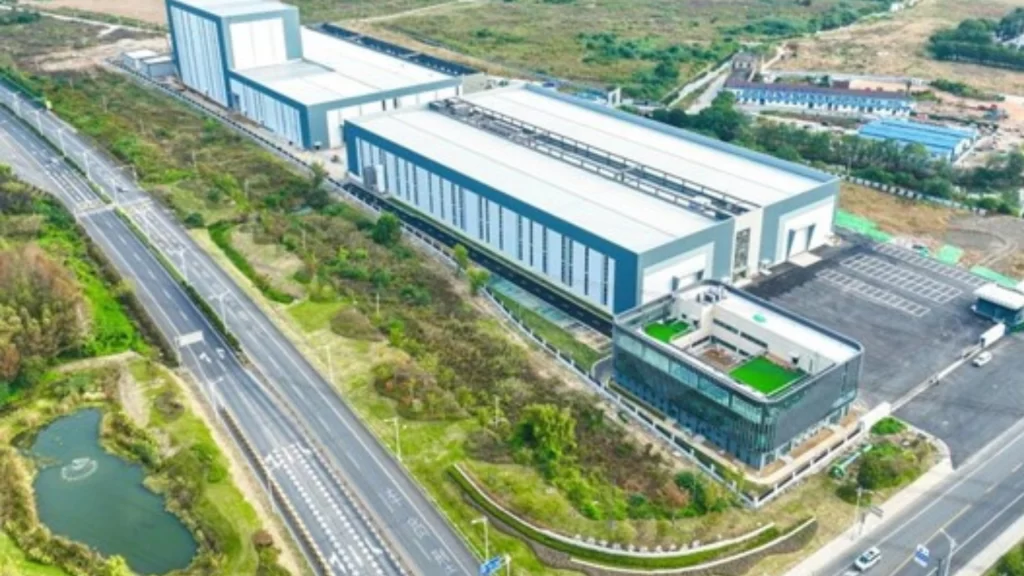
At the same time, construction of Land Space’s future main manufacturing base for the Zhuque-3 rocket has entered its final phase in Huishan High-Tech Zone in Wuxi, east China’s Jiangsu province.
Why did Land Space choose Huishan High-Tech Zone for its production base? According to a company executive, “After evaluating multiple cities, we found that within a 50-kilometer radius of the zone, all the necessary raw materials and component suppliers are readily available. In particular, local suppliers can provide 90 percent of critical engine production materials.
Huishan High-Tech Zone has grown out of Luoshe township in Huishan district, Wuxi, a traditional industrial township with a solid manufacturing foundation and a complete range of industries. In 2021, Luoshe was approved to establish Huishan High-Tech Zone. That same year, it set its sights on emerging industries and launched the Wuxi Aerospace Industrial Park.
Land Space is not the only company here that aspires to space exploration. JTSPACE, a private company in the burgeoning commercial space market, has built a production base in the zone for key components of synthetic aperture radar (SAR) satellites. By adopting integrated, standardized, and modular design concepts, the company has made satellite manufacturing as efficient and streamlined as home-appliance production, helping commercial satellite production shift from small-batch, bespoke builds confined to laboratories to standardized, large-scale assembly-line manufacturing.
In orbit, commercial meteorological satellites operated by Tianjin Yunyao Aerospace Technology Co., Ltd. circle the Earth once every hour and a half, monitoring global weather patterns. Li Fenghui, chairman of the company, said the company placed its meteorological satellite R&D, manufacturing, and data-application projects in Huishan because of the district’s efficient administrative services and high-standard facilities. “In less than a month, we recruited nearly 20 professionals in meteorology,” he noted.
While the aerospace industry continues to push toward space and near-space frontiers, the low-altitude economy is steadily integrating into everyday work and life. At the Asia-Pacific headquarters showroom of Magnus Aircraft in Huishan High-Tech Zone, a Fusion 212 aircraft stands out. This two-seat light sport aircraft features a lightweight carbon-fiber airframe, with a top speed of 256 kilometers per hour. According to the company, more aircraft models, including the Fusion 212, are expected to be produced at the Huishan facility.
Applications of the low-altitude economy are becoming increasingly diverse in Huishan. A drone-based blood delivery route now links Wuxi Central Blood Station with Wuxi Huishan District People’s Hospital.
By integrating artificial intelligence and drone technologies, the route, with a blood cold-chain management system and a blood dispatch platform, addresses inefficiencies and traffic-related disruptions in ground transport.
As a result, emergency blood delivery time has been reduced from around an hour to just over 10 minutes, significantly enhancing medical support capacity and securing patients’ precious “golden rescue time.
Along this path toward renewal, traditional manufacturing in Huishan is accelerating its transition toward intelligent production. Miracle Automation, once a small mold-making factory, has grown into an internationally recognized manufacturer of intelligent automation. In recent years, the company has made embodied intelligent robotics a key strategic focus, reaching cooperation intentions with several leading new-energy vehicle manufacturers on robotics applications.
Recently, an embodied intelligent robotics industrial data center built by Miracle Automation was put into operation. Covering about 7,000 square meters, the center integrates multiple functions, including real-world application training, simulated environment training, data collection, and multi-modal large-model training. In its initial phase, it can support the simultaneous training of more than 100 robots, providing a strong platform for the next stage of intelligent manufacturing development.
Source: People’s Daily