

By Li Jie
In 2025, China’s economy will continue to move forward under pressure while advancing toward higher quality and greater innovation. A closer look at a series of keywords offers a vivid sense of the vitality and momentum driving China’s economic development.
Trade-In Programs
Since the beginning of the year, China has expanded and strengthened its large-scale equipment upgrade and consumer goods trade-in programs. According to data from the Chinese Ministry of Commerce, from January to November, the consumer goods trade-in program generated more than 2.5 trillion yuan ($355.69 billion) in related sales.
The program has benefited over 360 million transactions nationwide, including more than 11.2 million vehicles, over 128 million household appliances, and more than 90 million digital products such as smartphones, as well as over 120 million items of home decoration and kitchen-and-bathroom products.
Beyond stimulating consumption, trade-in policies have accelerated consumption upgrading, with growing demand for greener, smarter, and higher-quality products. From January to November, production and sales of new energy vehicles reached 14.907 million and 14.78 million units respectively, representing year-on-year growth of 31.4 percent and 31.2 percent.
New Consumption Scenarios
Across China: Innovative consumption scenarios are reshaping everyday experiences. In Shandong province, former industrial sites have been transformed into science education and interactive cultural tourism destinations featuring immersive theatrical experiences. In Guizhou province, expressway service areas are evolving from simple rest stops into multifunctional consumption hubs.
Integrated and scenario-based innovations are offering consumers more personalized experiences. The rapidly growing nighttime economy, for example, is shifting from traditional food- and shopping-centered night markets to comprehensive nighttime cultural and tourism zones that blend culture, travel, and entertainment.
China’s National Development and Reform Commission noted that advances in tech products, digital technology, and artificial intelligence are continuously giving rise to new business models and scenarios. Immersive and experience-oriented consumption formats are expanding, while e-commerce, livestream commerce, and online entertainment continue to thrive, unlocking vast consumption potential in the years ahead.
Robots
Experts believe that humanoid robots could become the next disruptive product after smartphones and new energy vehicles, with broad applications in household services, manufacturing, warehousing, and logistics.
Backed by strong industrial foundations and a robust innovation ecosystem, China’s robotics industry has expanded rapidly. Data from the National Bureau of Statistics show that from 2020 to 2024, revenue in China’s robotics sector rose from 106.1 billion yuan to 237.89 billion yuan, with an average annual growth rate of 22.4 percent. Industrial robot output increased from 212,000 units to 556,000 units, growing at an average annual rate of 27.3 percent. China has firmly established itself as the world’s largest producer of robots.
Village-Branded” Cultural and Sports Events
In Rongjiang County, Guizhou Province, the grassroots football tournament known as the “Village Super League” has brought renewed vitality to local development. Similar “village-branded” events are now flourishing nationwide, including village basketball leagues, village fashion shows, village concerts, and village galas, offering a vivid glimpse into the diversity and dynamism of rural China.
As cultural and sports activities spread across the countryside, more people are choosing to reconnect with rural life, natural landscapes, and agricultural experiences. Behind the popularity of these “village-branded” events lies the vast potential of China’s county-level markets. From January to November, retail sales of consumer goods in counties, townships, and rural areas accounted for 38.7 percent of the national total.
Silver-Hair Tourism Trains
Recently, a special tourism train carrying more than 700 senior travelers from Shenyang, northeast China’s Liaoning province, arrived in Kunming, southwest China’s Yunnan province, opening a 15-day “winter escape” tour.
Across China, customized tourism trains are being introduced with flexible routes and attentive services tailored to senior travelers. Facilities such as lighting, handrails, seating, and restrooms have been upgraded to better meet seniors’ needs, making travel safer and more comfortable.
By the end of 2024, China’s population aged 60 and above reached 310.31 million, accounting for 22 percent of the total population, while average life expectancy rose to 79.0 years. Senior travelers now represent more than 20 percent of all domestic tourists. As local governments continue to develop age-friendly tourism products and routes, the silver-hair tourism market is expected to unlock even greater potential.
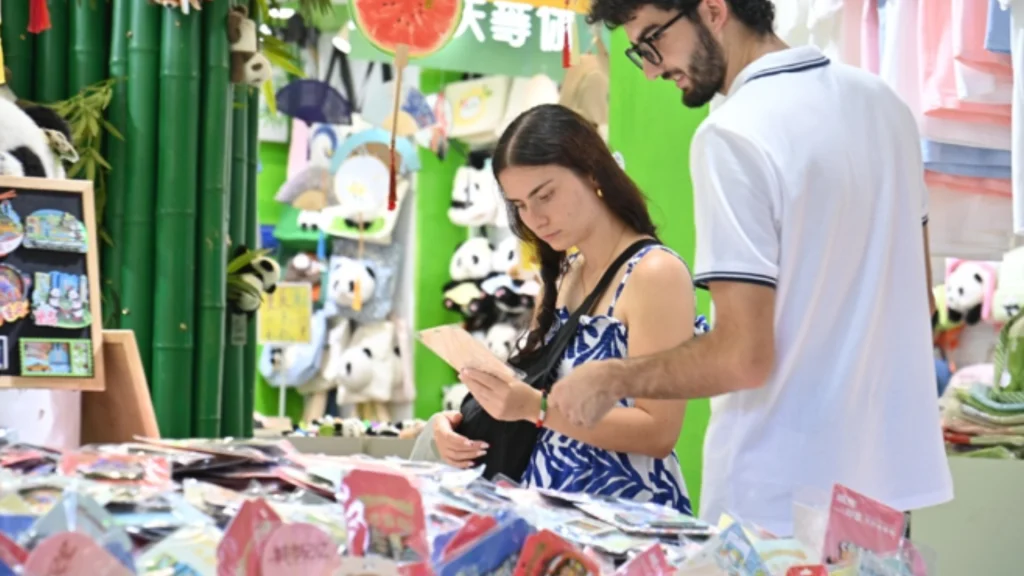
Shopping in China.
From ice and snow experiences in northeast China to tropical vacations in Hainan province, from in-depth tours of the Yangtze River Delta to scenic routes across northwest China, foreign visitors are exploring China in increasingly diverse ways.
On Dec. 17, 2024, China extended its existing 72-hour and 144-hour visa-free transit policies to a unified 240-hour stay. The policy now applies to travelers from 55 countries. Simplified visa procedures, longer visa-free stays, and more efficient border clearance have made spontaneous travel to China far more accessible.
According to China’s National Immigration Administration, since the extension of visa-free stays, 40.6 million foreign nationals had entered China via various ports nationwide as of December 16, up 27.2 percent year on year. The number of travelers eligible for the 240-hour visa-free transit increased by 60.8 percent compared with the period before the policy adjustment.
Many foreign social media influencers advise travelers to China to bring an extra suitcase. From smart goggles and virtual reality devices to drones, high-quality and competitively priced Chinese-made products have won widespread popularity among overseas visitors. As of the end of August 2025, China had more than 10,000 tax refund stores catering to foreign visitors—three times the number at the end of 2024—with tax refund volumes surging sharply in the first three quarters.
Source: People’s Daily




Shaping Multipolar Order: SCO Expands Strategic Role on 25th Anniversary