
By Li Bin
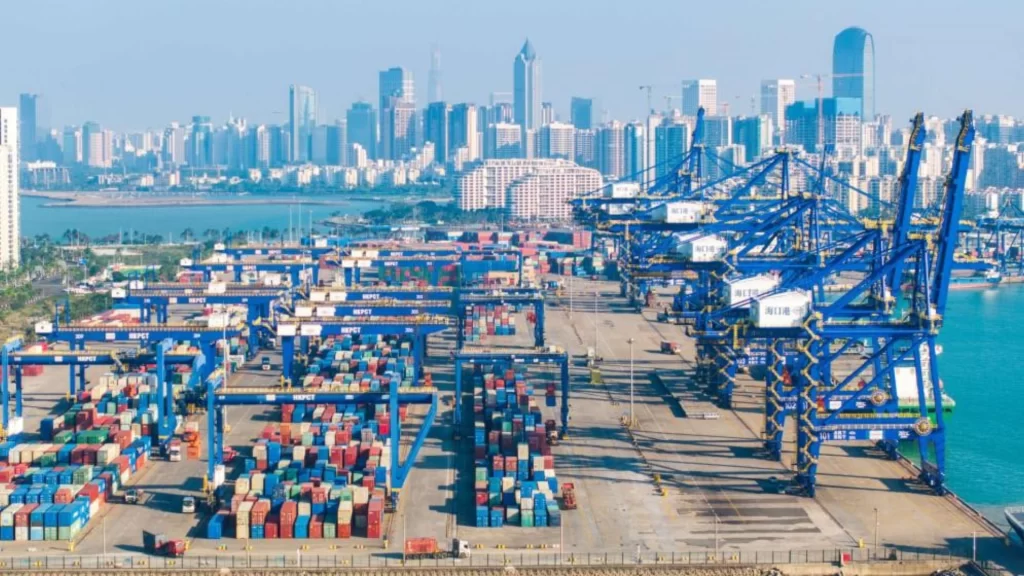
On Dec. 18, 2025, the Hainan Free Trade Port (FTP) officially launched island-wide special customs operations. Known in ancient times as a “remarkable land in the southern seas,” Hainan today is riding a powerful wave of opening up with strong momentum for development.
China is working to build the Hainan FTP into a key gateway for opening up in the new era, demonstrating unwavering confidence in advancing high-level opening up and a major country’s commitment to sharing development opportunities with the rest of the world.
As the world’s largest free trade port by area, the Hainan FTP has progressed from vision to reality, and from pilot exploration to taking shape and gathering momentum. Its progress reflects both bold experimentation and proactive reform, as well as prudent governance marked by a well-calibrated pace of opening up and strengthened risk identification and prevention.
Inside an exhibition hall in the Yangpu Economic Development Zone in Danzhou, Hainan, a glass wall displaying a chronological list of milestones achieved by Hainan comes into view: the country’s first independent foreign-run university; Yangpu’s first “zero-tariff” import of self-use production equipment; the first foreign-invested international vessel registered under China’s flag; and the nation’s first digital bonded zone. These milestones vividly illustrate China’s steady expansion of institutional opening up in areas such as rules, regulations, management, and standards.
While the physical free trade port is advancing at full speed, relevant institutional reforms are gaining strong momentum. Before the launch of the island-wide special customs operations, key policies—such as “freer access at the first line, regulated access at the second line,” and a negative list for cross-border trade in services—were piloted in designated areas, including the Yangpu Bonded Port Area and the Jiangdong New Area in Haikou, the capital of Hainan province. After experience was accumulated, these policies were extended across the island—a step-by-step approach that effectively reduced systemic risks and trial-and-error costs.
The development of the Hainan FTP focuses on trade and investment liberalization and facilitation, with alignment to high-standard international economic and trade rules pursued in a China-oriented, inclusive manner. For example, while the negative list for cross-border trade in services draws on global practices, China retains regulatory initiative in key sectors such as culture and finance. At the same time, legislation has been strengthened in areas including port management, commercial aerospace, tropical rainforests, emerging industries, and foreign-related affairs, providing a solid legal foundation for institutional innovation.
“Special customs operations” are not the ultimate goal, nor does opening up equate to disorder. After special customs operations begin, the free trade port will operate under a model of “freer access at the first line, regulated access at the second line, and free flow within the island,” ensuring that opening up expands in a safer, more orderly, and more efficient manner.
At the mouth of the Ningyuan River in Yazhou Bay, Sanya, Hainan, imported seeds begin their journey into China by first arriving at a facility called Moon Island. There, they undergo quarantine cultivation at the Global Transfer Base for Introducing Animal and Plant Germplasm Resources before being introduced to other regions, which ensures biological security throughout the process.
In practice, risks related to duty-free consumption are managed through quota controls; key sectors avoid mechanically copying free-market models; and special-access pharmaceuticals are placed under monitoring and traceability systems. These measures both safeguard national sovereignty, security, and development interests, and provide a high-standard, predictable environment for the global flow of factors of production, underscoring a defining feature of China’s modernization path: the more China opens up, the greater emphasis it places on security.
The Hainan FTP is not an isolated case. From Shanghai’s Lingang area, advancing integrated urban and industrial development, to Shenzhen’s Qianhai in Guangdong province, building a new hub for modern services, and to the Xiong’an New Area in Hebei province, creating a digital twin city, reforms are thriving across the country. Growing through inheritance and innovation, and advancing through exploration and transcendence, these reform frontiers together showcase new dynamism in China’s pursuit of high-quality development.
Source: People’s Daily



Shaping Multipolar Order: SCO Expands Strategic Role on 25th Anniversary