By Yang Xun
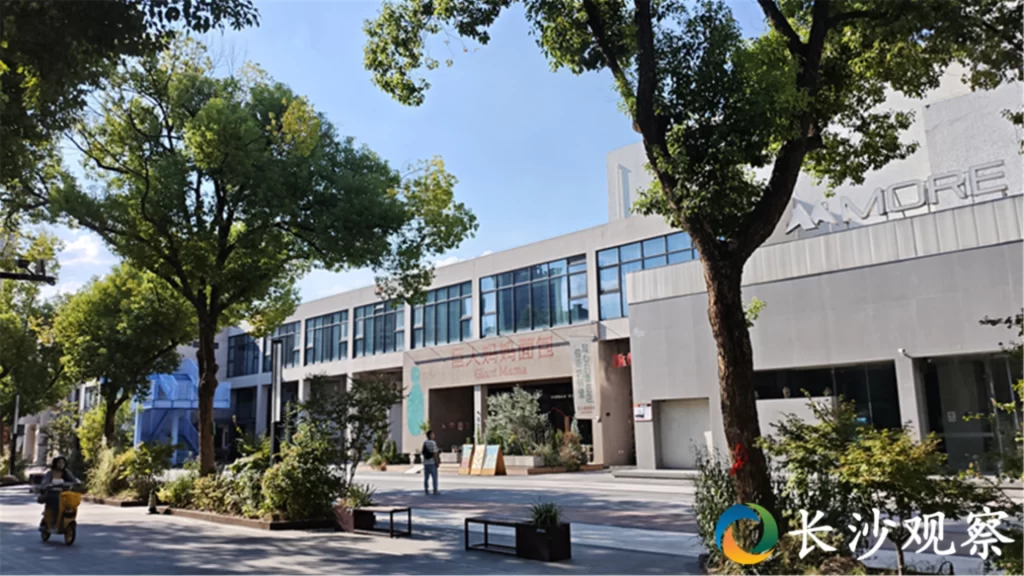
In the Jinxiu Shiguang block of Guanshaling, located within Changsha’s Xiangjiang New Area in Hunan province, central China, time appears to move at a gentler pace. Coffee shops and trendy restaurants line the streets, drawing crowds of both residents and visitors.
Just steps away, the bustling 14,400-square-meter Jinshang Fresh Food Market serves approximately 30,000 customers daily, meeting the needs of dozens of surrounding communities.
On a weathered red-brick wall in the block hang photographs comparing its past and present. Years ago, this area echoed with the roar of machinery and the whir of spinning frames — it was once home to a textile factory. Nie Lei, formerly head of the factory’s supply department, has witnessed the site’s entire transformation, from its heyday to decline, and now to renewed vitality.
Built in the 1980s, the factory was once a key base of light industry for the city of Changsha. “In its best years, its gate was crowded every morning with trucks lining up to haul goods,” Nie recalled.
By the 1990s, however, the factory began struggling and ultimately ceased production in 2006. Employees took different paths; some were reassigned, others started their own businesses. photographs hang
Watching the old plant gradually fall silent, Nie could not help but miss its former bustle. Aging facilities and dilapidated buildings stood in stark contrast to the office towers rising nearby. Photographs
After shutdown and restructuring, the site was corporatized as Changsha Boda Asset Management Co., Ltd., which continued to explore new directions of development.
A turning point came in 2020, when China’s 14th Five-Year Plan called for accelerating urban renewal, including the upgrading of old residential areas, factory sites, neighborhoods, and urban villages to revitalize underused urban spaces.
The factory was soon designated a key and pilot project for urban renewal in the city. The southern part of the site was redeveloped into a fresh food market and a food street, incorporated into a program for upgrading major urban facilities. The northern part became the Jinxiu Shiguang block, the city’s first pilot project to reutilize an old industrial plant.
“Hearing this news, I suddenly saw hope that the factory area would come alive again,” Nie said.
The renovation was undertaken by Changsha Boda Asset Management Co., Ltd., where Nie works. “The project is positioned as a new-generation urban market that blends trendsetting consumption with everyday life,” said Shen Zhaohui, an executive of the company. “We have explored new approaches in industrial heritage protection, planning and implementation, architectural renovation and design, as well as asset restructuring and operation.”
The transformation was driven by three key dimensions of renewal: industrial function, visual identity, and spatial experience.
Industrial reinvention merged work, living, education, and leisure into a cohesive ecosystem. This was achieved by integrating new developments with renovated historical structures, strategically introducing higher-density urban functions, such as hotel-style apartments and commercial services, into the low-density spatial framework of the repurposed factory buildings.
Visual revitalization created a harmonious blend of old and new, fostering an attractive, livable, and dynamic environment. The arrival of well-known brands across dining, daily conveniences, and entertainment turned the block into a vibrant contemporary hub.
Spatial re-imagination fused industrial heritage with modern design in the landscape and architecture. By connecting once-fragmented pockets of space, the renewal crafted seamless, artistic, and practical settings for new forms of consumption and social engagement.
With approximately 60,000 square meters of revitalized space and an occupancy rate exceeding 90 percent, the area now operates as a park-like, smart, and green cultural block. It successfully brings together lifestyle scenes, industrial heritage, commercial experiences, and ecological wellness. The annual market turnover has reached nearly 1 billion yuan. Management revenue surged from 3.79 million yuan to over 40 million yuan, while the project also contributes nearly 50 million yuan in annual local tax revenue and provides around 4,000 jobs.
“This place preserves the memories of us veteran factory workers while also becoming a popular destination,” Nie said. “I hope it remains vibrant and evolves from a trendy hotspot into an enduring landmark.
Source: People’s Daily