
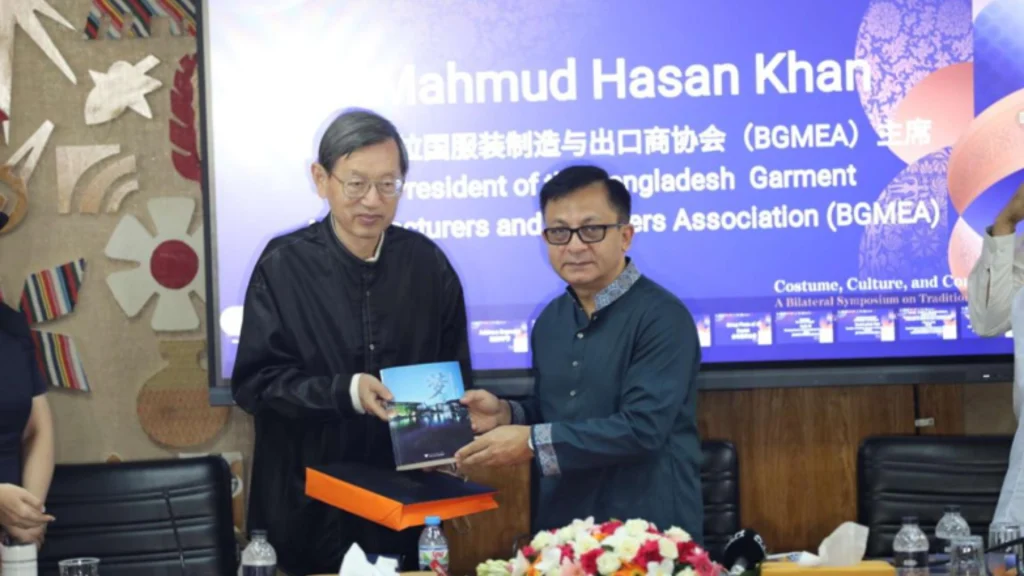
Amid the profound and warm atmosphere of China-Bangladesh high-level friendly exchanges and civilizational dialogue, I joined the academic delegation of Zhejiang Sci-Tech University for an in-depth field investigation in Dhaka, the capital of Bangladesh. Centering on textile culture inheritance, garment industry development, Sino-Bangladeshi people-to-people exchanges, and mutual learning between oriental civilizations, this field research recorded the real developmental status, humanistic temperament, and spiritual vitality of contemporary Bangladesh.
August falls within the typical rainy season in Bangladesh, with frequent rainfall every day. However, when the plane gradually descended over Dhaka, the gloomy clouds dispersed and bright sunshine spread across the land. Stepping out of the cabin, the warm and humid monsoon breeze swept over my face, bringing a vivid and tangible first impression of this water-rich South Asian country. Beneath the damp soil and crisscrossing water networks lies tenacious vitality and endless upward power.
This field trip continues my long-term Silk Road cross-border investigation and cultural research. Different from the arid and vast landforms of inland Silk Road countries, Bangladesh is a river-laced country nurtured by the Ganges Delta. This South Asian journey enabled me to move beyond textual materials and news reports, observe the most authentic social changes, industrial operation status and folk living conditions of Bangladesh on the spot, and deeply perceive the unique charm of delta civilization.
Dhaka is a crowded and lively mega-city. Rickshaws with colorful hand-painted patterns shuttle through urban streets. Painted with peacock totems, traditional Mughal patterns, and local folk paintings, these small vehicles constitute the most distinctive urban landscape of Dhaka. These simple and exquisite hand-painted artworks rooted in grassroots life reflect the optimistic attitude of ordinary people towards life under difficult living conditions and interpret the simplest and most powerful sense of human dignity of this land.
In the inherent impression of the international public, Bangladesh is often labeled as poor, crowded, and disaster-prone. However, after close field observation, I found that this land that has endured floods, storms, and historical turbulence is quietly writing a tenacious modern development story and brewing huge developmental potential.
As a member of the advance working group of the 2026 China-Bangladesh Bilateral Symposium on Mutual Learning and International Communication of National Costume Civilizations, I arrived in Dhaka four days in advance to carry out pre-meeting investigation and cultural exchange work. During the preparatory period of the conference, I invited Muhammad A. Khan, founder of Hand Touch Institution and member of the International Silk Union, to accompany me on street visits, industrial research, and folk cultural investigations in Dhaka.
At our first meeting, we carried out sincere cultural exchanges through books. Mr. Khan presented me with multiple collections of poems by Tagore, the great Bengali litterateur, while I presented my compiled work, the 2013 Hangzhou Silk Blue Book. The book exchange spanning China and Bangladesh marked the beginning of this in-depth cross-cultural communication, reflecting the spiritual resonance between oriental literati who respect civilization and pursue beauty.
I specifically visited local garment processing enterprises in Dhaka. In the tidy and intensive workshops, a large number of young Bangladeshi female workers concentrate on sewing and processing work. With dexterous fingers and persistent perseverance, they support the country’s core export industry. Many workers told me that the garment industry provides precious employment opportunities for local women, helps them reduce their dependence on their families, achieve economic independence, and gain the chance to contact the outside world and change their own fate.
At the same time, objective field observation also shows that Bangladesh’s garment industry still has obvious bottlenecks in production management, process refinement, production efficiency, and industrial chain supporting facilities. As the pillar industry of the national economy, although it has a huge industrial scale and export volume, it has long remained in the low-end segment of the global textile and garment value chain, lacking independent brands and high-end customized production capacity.
According to official World Bank data, Bangladesh has maintained a stable annual economic growth rate of about 6%, showing strong economic resilience among South Asian developing countries. However, behind the brilliant macroeconomic data is the hard and plain life of ordinary people. With a per capita GDP of only 2,500 US dollars, most ordinary families are still struggling at the basic level of food and living security. The huge contrast between national economic growth and people’s difficult lives constitutes the most real and three-dimensional developmental appearance of contemporary Bangladesh.
Accompanied by Muhammad A. Khan, I visited the landmark super project of Bangladesh — the Padma Bridge, known as the “Dream Bridge of the Nation”. As the largest single overseas bridge project undertaken by Chinese engineering enterprises, the Padma Bridge officially opened to traffic on June 25, 2022. It completely ended the century-old ferry crossing history of 21 southern districts of Bangladesh, thoroughly connecting the traffic arteries of the north and south of the country.
The total investment of the Padma Bridge project is about 3.87 billion US dollars, all independently raised by the Bangladeshi government through national financial allocation, which fully reflects the firm determination of the country to address its underdeveloped transport infrastructure and realize national development. China Railway Major Bridge Engineering Group undertook the main bridge construction project with a contract value of 1.549 billion US dollars.
The construction difficulty of the Padma Bridge ranks among the highest in the history of global bridge engineering. The riverbed is composed entirely of loose and shifting fine sand, with an extremely unstable geological structure, and the pile foundation construction faced unprecedented challenges. Some bridge piles needed to be hammered 20,000 to 30,000 times to take root stably in the riverbed, creating a rare record in international bridge construction. Chinese engineers overcame multiple extreme difficulties such as complex geology, rainy-season construction and turbulent river water, and finally built this river-crossing grand bridge spanning the Ganges Delta with superb infrastructure technology, turning the century-old national dream of Bangladesh into a real passage connecting development and hope.
The four-hour round trip to the Padma Bridge allowed me to deeply experience the typical urban traffic characteristics of Dhaka — serious urban congestion. Dhaka has long been listed as one of the most congested cities in the world. Except for a small number of urban expressways, urban main roads, commercial areas and construction sections are almost in long-term traffic paralysis. Motor vehicles, battery rickshaws and manual rickshaws travel in mixed flow without strict lane division, with traffic participants relying entirely on mutual avoidance. Minor scratches and collisions are frequent, vehicle horns are endless, and traffic efficiency has long remained low.
From a dialectical perspective, severe traffic congestion also reflects the strong vitality of Dhaka’s urban development. Dense traffic flow represents concentrated population vitality, active commercial transactions and continuous economic circulation. Compared with some mature European cities with sparse traffic and sluggish commerce, Dhaka’s noisy and crowded streets symbolize a developing city sprinting forward at full speed and thriving upward. Of course, long-term traffic congestion also causes huge time cost, labor waste and social operation burden, which has become an important bottleneck restricting the high-quality development of Dhaka’s urban governance and needs systematic optimization and improvement.
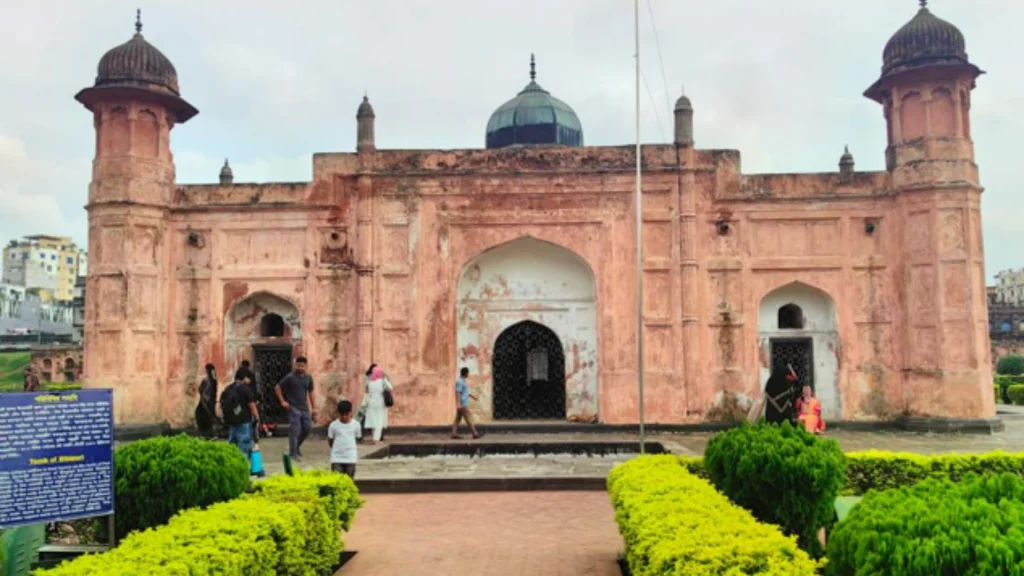
Away from the noisy urban streets, Lalbagh Fort, a 600-year-old Mughal architectural relic, carries the ancient humanistic memory of Dhaka. Built during the Mughal period, this red-brick ancient building witnessed the changes of dynasties and the vicissitudes of history.
It is often called the “Bangladeshi Taj Mahal” by tourists, but such a comparison is extremely superficial. The Taj Mahal is a perfect imperial monument built with supreme royal power and resources, while Lalbagh Fort is an unfinished historical relic whose construction was suddenly interrupted due to political turmoil. It has neither grand scale nor gorgeous decoration. Surrounded by dense urban residential buildings, the weathered red brick walls and lonely domes quietly stand in the old urban area. It is not a luxurious ornamental scenic spot, but a historical relic integrated into the daily life of local people, allowing citizens to stroll and relax in their spare time, bearing the ordinary warmth of urban life while carrying historical vicissitudes.
In-depth Interviews with Bangladeshi Writers: The Symbiosis of Literature and National Destiny
On the morning of August 14, I conducted exclusive in-depth interviews with three outstanding local writers in the quiet conference room of Le Méridien Dhaka. As the most sensitive observers of the times and disseminators of national spirit, writers can gain insight into the underlying context of social development and interpret the spiritual temperament of a nation, serving as an important bridge for cross-cultural and cross-national civilizational exchanges.
The whole interview was carried out in a standardized and sincere atmosphere. The Chinese and Bangladeshi sides greeted each other, introduced their respective research and creative fields, and presented their representative works to each other. The 83-year-old senior poet Zoha presented six collections of his original Bengali love poetry. I presented my academic monograph Beauty Shared in Diversity: Hangzhou Silk and the World. Poet Masuk gave two of his personal poetry collections, and I shared the poetry work Raging Winds by Chinese poet Huang Yazhou.
Language barriers separate geographical spaces, but literary warmth and spiritual resonance can cross national boundaries and transcend ethnic differences. Arif Rahman, a Bangladeshi doctoral student majoring in textile engineering at Zhejiang Sci-Tech University, assisted with real-time translation throughout the whole process, ensuring smooth, accurate, and in-depth cross-linguistic dialogue.
The three interviewees have distinct personalities and consistent literary pursuits. Octogenarian poet Zoha is hale and hearty, still adhering to literary creation with a walking stick in his old age, devoting his whole life to observing life and conveying warmth with poetry. The 56-year-old poet Masuk has sharp thinking and calm insight, always maintaining independent literary views and deep concern for the country’s development and people’s lives. Muhammad A. Khan, an industrial entrepreneur and literary enthusiast, is modest and courteous. Rooted in the local silk industry, he has long been committed to cultural inheritance and Sino-Bangladeshi exchanges, providing great support for this field investigation.
We launched in-depth discussions around literary creation concepts, the internal connection between literary development and national destiny, current social problems, and future development prospects of Bangladesh.
Senior poet Zoha said that he has long been committed to creating romantic poems focusing on human feelings, parting emotions and daily trivial warmth. Influenced by local classic poets in his youth, he has always insisted on recording all insights and perceptions in life with words. Even in his old age, he still keeps writing, guarding the most sincere human feelings and beautiful expectations for life through poetry.
Poet Masuk’s literary pursuit stems from his profound family heritage. His father was a famous local newspaper editor, poet, and philosopher, and his mother was an excellent female writer who actively advocated women’s education and dignity. Influenced by his family atmosphere since childhood, he firmly believes that literature is never personal entertainment, but a powerful spiritual force that carries public emotions, reflects social reality, and inspires national progress.
He reviewed the important role of literature in Bangladesh’s national awakening and independence movement. The classic works of Tagore, Nazrul Islam, and other predecessors inspired countless ordinary people and independence fighters during the 1952 Bengali Language Movement and the 1971 Bangladesh Liberation War, becoming the spark of national spiritual awakening. It fully proves that the rise and fall of literature is closely linked with the destiny of the country and nation.
As a practitioner integrating industry and literature, Muhammad A. Khan believes that literature is the mirror of the times and the guide of social progress. The prosperity of local literary and cultural undertakings is synchronized with the country’s economic development and social progress, and excellent literary works can condense national spiritual strength and promote positive social change.
In terms of the future development of Bangladesh, the three writers put forward frank and objective views from different perspectives.
Poet Zoha holds an idealistic and warm view that the foundation of national development lies in the kindness and love among people. When every citizen keeps goodwill and compassion, the whole society will be harmonious and progressive, and the country will surely move towards stable and healthy development.
Poet Masuk offered an analysis based on social realities. He pointed out that Bangladeshi youth are vigorous, independent, and full of strong patriotic feelings, and the country has a huge demographic dividend and development potential. However, long-term political instability and frequent power struggles have continuously wasted development opportunities, restricted the release of social vitality, and become core factors restricting national leapfrog development.
Entrepreneur Muhammad A. Khan analyzed the issue from an industrial and economic perspective. He believes that Bangladesh has complete basic industrial facilities and rich labor resources, with broad room for industrial upgrading. If the government can optimize governance efficiency, standardize administrative operations and effectively implement industrial support policies, the country’s textile, garment and related industries will usher in rapid take-off.
At the end of the interview, I asked the three writers for permission to publish the full interview record in Chinese mainland media. After reviewing the interview content, all of them gave their consent to publication. They also hoped this interview article could be disseminated in Bangladesh, enabling two-way cultural communication and mutual learning between China and Bangladesh. I promised to fully promote the mutual publication and communication of the article, to consolidate the folk friendship and cultural bond between the two countries. The whole interview was sincere and profound, resulting in a cross-border spiritual dialogue based on mutual respect and equal communication.
Glimmer of International Students: Youth Bonds of the Belt and Road Initiative
In grand national cooperation and cultural exchange events, the growth stories of Bangladeshi students studying in China constitute the warmest and most touching micro-perspective of Sino-Bangladeshi friendship.
Arif Rahman, who assisted the whole interview process, is a doctoral student majoring in textile engineering at Zhejiang Sci-Tech University. He completed his master’s and doctoral studies in China. When talking about the reason for choosing Chinese universities, he said that China has the world’s leading textile discipline system, complete teaching resources, and mature industrial technology experience, which together provide an ideal platform for young people who aspire to engage in textile research. The good academic atmosphere, rich international exchange platforms, and perfect scholarship policies enable overseas students to concentrate on academic research and professional growth.
Arif has clear and firm life planning. After graduating with a doctorate, he plans to devote himself to green textile technology, intelligent manufacturing, and innovative fabric research and development. He is determined to take China’s advanced textile technology, mature industrial management mode and innovative research achievements back to Bangladesh, promote the upgrading of the local textile industry, cultivate professional industrial talents for his motherland, and build a youthful bridge for Sino-Bangladeshi industrial cooperation and cultural exchanges with practical actions.
Born into an ordinary poor family in Bangladesh, Arif has faced many difficulties in his studies and life. Due to a delay in scholarship disbursement and his mother’s illness, he once came under severe financial pressure and faced a difficult personal situation. At the most difficult time, his supervisor, Professor Li Qizheng, gave him timely help, covered his family’s medical expenses, and helped him tide over the crisis.
This warm cross-border teacher-student friendship is a microcosm of the people-to-people friendship under the Belt and Road Initiative. Behind the grand national strategic cooperation are countless ordinary people’s mutual help, sincere friendship, and joint struggle. Overseas students are the liveliest and most dynamic youthful carriers of Sino-Bangladeshi civilizational mutual learning and industrial connection, weaving continuous emotional bonds between the two countries.
High-Level Academic Summit: Government Empowers Industry, Civilization Integrates with Practice
On August 17, the 2026 China-Bangladesh Bilateral Symposium on Mutual Learning and International Communication of National Costume Civilizations was held in Dhaka. This high-standard academic exchange activity has attracted considerable attention from the Bangladeshi government. Khandker Abdul Muktadir, Minister of Commerce, Industry, Textiles and Jute of Bangladesh, attended the conference and delivered an in-depth speech, injecting national strategic guidance and industrial practical significance into the cultural and academic exchange activity.
The middle-aged minister is rigorous, efficient, and pragmatic. He delivered an impromptu in-depth analysis of the current situation, structural bottlenecks, and transformation paths of Bangladesh’s textile and garment industry from the perspective of national top-level design. He pointed out that the ready-made garment industry is the absolute pillar of Bangladesh’s national economy, with annual export volume reaching about 80 billion US dollars, making it a core pillar of Bangladesh’s foreign trade.
At the same time, he frankly admitted that the local garment industry has long faced structural shortcomings: insufficient deep processing capacity of products, low added value of export goods, lack of independent brand influence, and obvious gaps in the high-end links of the industrial chain compared with international advanced levels.
The minister stressed that Bangladesh has a relatively complete textile industrial foundation and huge development potential. The current industrial difficulties are only transitional problems in the process of development and upgrading, not inherent deadlocks. The government has formulated a clear industrial upgrading strategy: build professional industrial laboratories and big-data governance platforms, empower traditional manufacturing industries with modern science and technology; vigorously develop raw material deep processing and composite fabric innovation, improve product quality and production efficiency; optimize national industrial layout and integrate resource advantages to expand development space.
In terms of industrial talent training, Bangladesh takes Sino-Bangladeshi educational cooperation as a key breakthrough for industrial upgrading. China’s complete textile industrial chain, mature technical experience, and systematic talent training system provide important reference templates for Bangladesh’s industrial transformation. At present, many local universities in Bangladesh have set up Chinese language courses and Chinese cultural courses, invited Chinese professors to teach in schools, aligned local talent training schemes with advanced Chinese teaching systems, and cultivated a large number of young professionals who can adapt to the modernization of the textile industry, laying a solid talent foundation for the inheritance of national costume culture and industrial innovation and development.
This Sino-Bangladeshi symposium goes beyond the purely theoretical discussion of traditional cultural exchange activities. It organically integrates academic dialogue, civilizational mutual learning, industrial practice exploration, and government policy support, realizing the organic integration of cultural communication and practical industrial cooperation, and turning costume cultural research into tangible bilateral cooperation opportunities.
I was invited to deliver a keynote speech titled The Development Path of Chinese Garment Enterprises. Yu Xiaona from the editorial department of Silk Journal was responsible for on-site translation and document sorting, and Hu Yang from Zhejiang Sci-Tech University completed the English on-site presentation of the speech. Based on decades of practical experience in the textile and garment industry, I sorted out the development trajectory of Chinese silk and garment enterprises from small processing workshops to national benchmark export enterprises, and shared China’s mature experience in brand building, industrial upgrading, and cultural integration with Bangladeshi industry colleagues.
At the end of the summit, a wonderful Sino-Bangladeshi traditional costume show was staged. The classic costumes of China and Bangladesh appeared on the same stage, showing the consistent oriental aesthetic connotation and the integration and mutual learning of national costume cultures across mountains and seas. The elegant clothing interpretation inherits the spiritual origin of oriental aesthetics, witnesses the continuous cultural exchanges on the new Silk Road, and brings the preliminary preparation work of the Chinese advance team to a close.
On August 18, the research team flew to Rajshahi, known as the “Silk City” and “Royal City” of Bangladesh. Located on the bank of the Ganges River, Rajshahi borders India across the river and has a long history of silk textile culture.
We conducted an on-site investigation of the long-idle local silk industrial park, which had been abandoned for decades and had fallen into a state of shutdown and stagnation. This key investigation has attracted extensive attention from local mainstream media in Bangladesh, with dozens of media outlets following up and reporting. The nationally influential English daily The Daily Sun published a special long report on our field research the next day. In my opinion, media attention is a good start for the revival of the Rajshahi silk industry, but the revitalization of the declining silk city requires long-term investment, persistent efforts, and strong policy promotion from relevant departments.
Urban Landscapes: From Fragmented History to Modern Institutional Order
On the morning of August 19, we visited Jatiyo Sangsad Bhaban, the national parliament building of Bangladesh, a world-class architectural masterpiece designed by the famous architect Louis Kahn.
Unlike the unfinished, weathered Lalbagh Fort, which represents an earlier historical era, the National Parliament Building presents a solemn and powerful modern institutional temperament with minimalist geometric lines, thick fair-faced concrete walls, and layered light and shadow structures. In response to Bangladesh’s tropical monsoon climate, the building adopts a porous wall design, forming a quiet, sacred and orderly internal space. The rough concrete texture bears the traces of age, showing the simplicity and grandeur of modern architecture.
This land has experienced long-term wars, regime changes, and social turbulence. Located beside the artificial lake, the majestic parliament building stands steadily, becoming the core symbol of Bangladesh’s modern institutional order. It witnesses the historical transformation of Bangladesh from turbulence and chaos to stability and governance, from disorderly struggle to rational development and steady progress. It carries the young country’s yearning for the rule of law, social order, and peaceful development, and is a solid carrier of Bangladesh’s modern national spirit.
Reflections upon Return: Resilience and Rebirth in Contradictory Realities
In international public perception, Bangladesh is often defined as a fragile country frequently hit by natural disasters such as floods and cyclones, with scarce natural resources and a dense population. However, this land also shows remarkable resilience and vitality. It supports nearly 180 million people on limited land, relies on the garment industry to create an annual export volume of tens of billions of US dollars, and tenaciously moves forward in adversity and difficulties.
Through this in-depth field investigation, I have encountered a three-dimensional, real and vivid Bangladesh beyond textbook definitions and news fragments. It is humid and noisy, full of contradictions and hardships, but always full of upward vitality. It is constantly seeking breakthroughs in predicaments, exploring development paths in hardships, and breaking external prejudices through practical growth.
The real Silk Road cultural communication never relies on empty slogans and grand narratives, but comes from observing ordinary people’s lives, perceiving trivial life hardships, respecting the unique civilization and development path of each country, and realizing equal dialogue and sincere mutual learning.
From ordinary female workers sewing diligently in workshops to elderly poets who still hold pens to warm the world; from young overseas students who take root in professional research and aspire to serve the country to industrial practitioners who adhere to cultural inheritance; from high-end academic dialogue platforms for civilizational mutual learning to practical industrial cooperation blueprints for common development — the new-era Silk Road goes far beyond simple commodity trade and economic circulation. It is a warm spiritual passage connecting people’s hearts, integrating diverse civilizations and leading all parties to pursue a shared future.
By Fei Jianming


Shaping Multipolar Order: SCO Expands Strategic Role on 25th Anniversary