
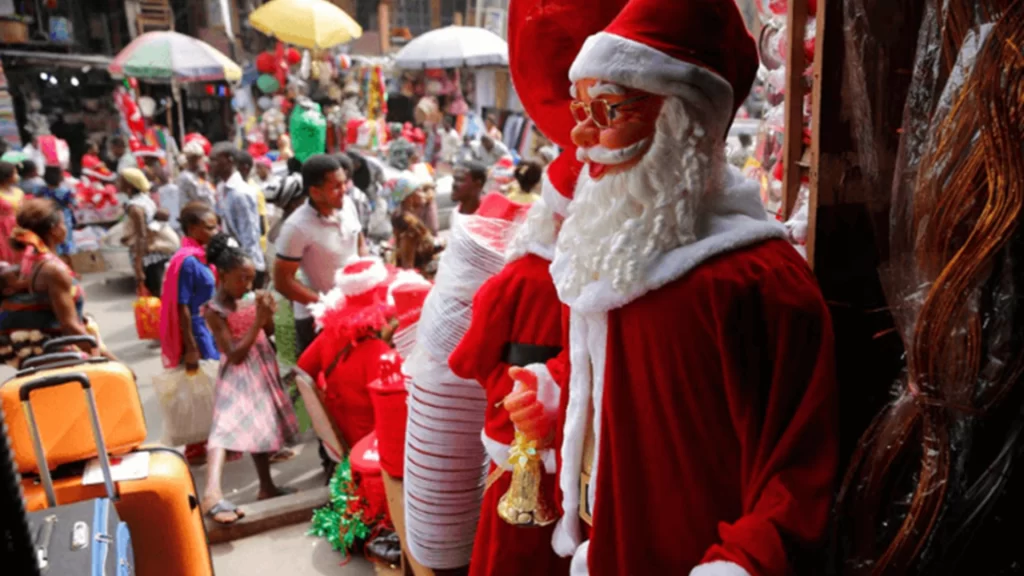
At the Balogun Market in Lagos, the walkways were crowded, voices rose over one another, and Christmas music played faintly from a nearby stall. At first glance, it felt like any other festive season. But the real story is not in the number of people passing through, but in what they leave with.
Funke Adeyemi, who sells food items and groceries, said, “People are buying, but they are buying small.” She pointed at half-filled sacks of rice in a corner of her stall. “Last year, many customers bought full bags for Christmas. This time, most ask for cups or a few kilos. Everyone is careful.”
Across Nigeria, inflation has quietly reshaped how families approach Christmas. Official data show food inflation at 24.7 percent in December, and the effect is visible in market prices. A 50kg bag of local rice now sells for between ₦65,000 and ₦70,000 in major cities, up sharply from last Christmas. Chicken, tomatoes, and cooking oil have followed the same upward path, making the traditional festive meal more expensive to prepare.
For shoppers like Peace Ike, a civil servant from Abuja visiting family in Lagos, the market trip is an exercise in restraint. She moves from stall to stall, comparing prices, mentally editing and rewriting her shopping list. “You adjust as you go,” she said. “Some things you drop, some you reduce. New Year’s celebration will still come.”
Back at her home in Kubwa, Abuja, those adjustments are already shaping the day itself. The usual plan of hosting extended family has been shelved. “We’ll cook for ourselves and maybe visit relatives after church,” she said. “It’s not ideal, but this is our reality now.”
Transport costs have further narrowed options for many families. In cities across the country, fares have risen since mid-year fuel price changes, especially those on the highway, forcing people to rethink long-distance travel. In Lagos, technician Tunde Olawale decided not to travel to Ondo State this year. “The transport money alone is too much,” he said. “We’ll stay back and make do.”
For small traders, Christmas normally brings a burst of sales that carries them into the new year. This season has been slower. Similarly, a gift seller, Musa Abubakar, said customers are choosing simpler items. “People still want to give something, but they choose the cheapest option,” he said. “Sometimes they just ask the price and walk away.”
Economists say these patterns are typical during prolonged periods of high inflation. As household incomes struggle to keep pace with rising prices, discretionary spending shrinks. What is striking this year, however, is how widespread the adjustments have become, cutting across income levels and regions.
Still, the festive spirit has not disappeared. In some neighborhoods, families are sharing meals or organizing small community gatherings. Churches have become focal points, offering not just worship but a sense of collective endurance.
At a modest Christmas service in Abuja, some congregants shared plates of rice and soft drinks after prayers. There was no excess, but there was warmth. “We thank God for what we have,” one man said. “Next year will be better.”
This Christmas, we are celebrating differently. The food is less, the journeys shorter, the gifts smaller. Yet in markets, homes, and churches, the season endures, reshaped by hardship, but not erased by it.




Shaping Multipolar Order: SCO Expands Strategic Role on 25th Anniversary