
By Zhao Yongxin
For people living in high-altitude pastoral areas, access to fresh vegetables has long been constrained by harsh natural conditions, with limited varieties available throughout the year. For nearly two decades, Wang Zhonghong, a professor at Xizang Agricultural and Animal Husbandry University, has been working to change that.
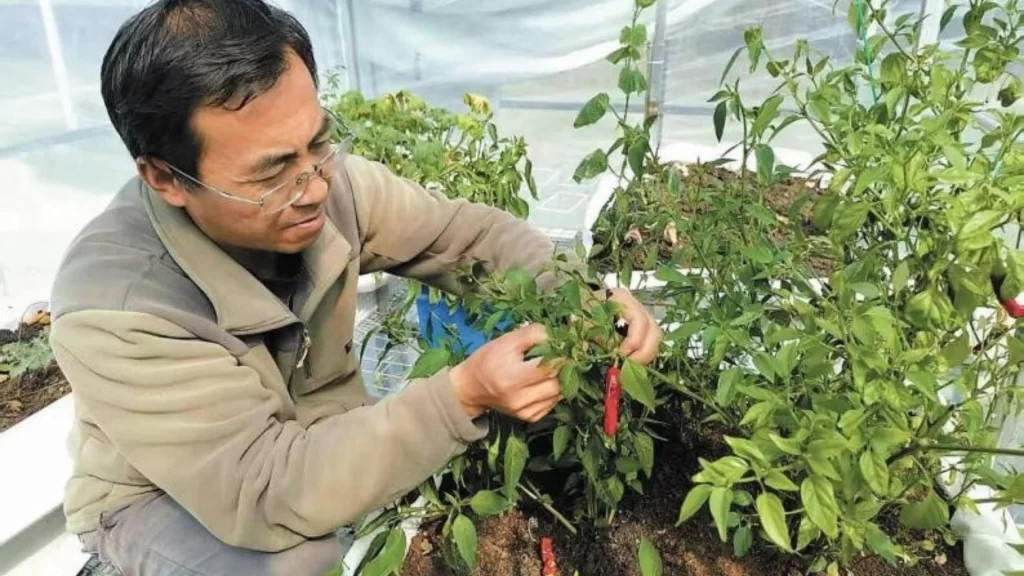
Inside a courtyard greenhouse on the Qinghai-Xizang Plateau, Wang climbed up and down a small ladder, pointing out the different crops growing at each level.
“The top layer gets the strongest sunlight and the highest temperatures, so we grow watermelons, eggplants, and chili peppers on it,” he said. “The middle layer is cooler and less sunny, which suits radishes, cabbage, and cauliflower. The bottom layer has the weakest light and lowest temperature, so it’s ideal for spinach, lettuce, and chives.
This multi-layer planting system is part of Wang’s long-term research on high-altitude courtyard greenhouses, a facility he has spent years refining. His goal is simple but ambitious: to make it possible for farmers and herders in high-altitude regions to enjoy fresh vegetables throughout the year.
Born and raised in northwest China’s Ningxia Hui Autonomous Region, Wang had no prior connection with Xizang. While pursuing graduate studies at Northwest Agriculture and Forestry University in northwest China’s Shaanxi province, however, he was struck by a comment from his advisor: the Qinghai-Xizang Plateau is rich in wild vegetable resources, yet its vegetable industry remains underdeveloped.
When universities in Xizang came to recruit faculty members in 2006, Wang made a decisive choice. “If I went to Xizang,” he recalls, “I could teach and conduct vegetable research at the same time. He gave up a job he had already lined up and headed for the plateau.
Upon his initial arrival, Wang became deeply fascinated with the region. He learned that wild Allium plants—relatives of onions and chives—are especially abundant on the plateau. Of the more than 1,000 species worldwide, over 60 are found in the region, offering significant development potential.
Turning wild plants growing at elevations of 4,000 to 5,000 meters into vegetables suitable for everyday meals, however, was no easy task. Outside the classroom, Wang led his students through years of painstaking work: surveying wild resources, establishing germplasm nurseries on campus farms, and selecting superior strains.
Eventually, he mastered artificial cultivation techniques for Allium przewalskianum, an Asian species of wild onion in the Amaryllis family and a native wild Allium species. The domesticated plants grew well and had a rich flavor, but providing a wider variety of fresh vegetables for local households remained his larger concern.
That led him to focus on courtyard greenhouses.
“High-altitude areas are cold and windy year-round, especially in winter, which makes conventional large greenhouses impractical,” Wang explained. Most local residential buildings are two stories tall and surrounded by courtyard walls one to two meters high. These enclosed spaces naturally block cold winds and create small, relatively stable microclimates—ideal conditions for a different kind of greenhouse.
In the autumn of 2014, Wang built his prototype: a small arched greenhouse with three planting layers. It soon proved inadequate; the structure was too low, and sunlight was blocked by courtyard walls.
He experimented with movable designs to improve lighting, but steel-frame structures turned out to be too heavy to move easily. Eventually, he returned to a fixed design, raising the height to five or six meters and creating a double-layer structure with an inner and outer greenhouse.
By 2018, after repeated trials and adjustments, the courtyard greenhouse took its basic form. Wang continued refining it. He optimized the spacing between the inner and outer layers and added thermal insulation blankets to improve heat retention.
Each layer was fitted with 12 planting boxes: the upper layer for heat- and light-loving vine crops, the middle for vegetables with moderate requirements, and the lower for shade- and cold-tolerant leafy greens.
“The guiding principle is simple,” Wang said. “The greenhouse must be safe, reliable, easy to operate, and easy to maintain—something farmers and herders can use well and use for a long time.
Through continuous improvements, the design has now reached its seventh generation. A 49-square-meter courtyard greenhouse can accommodate up to 36 different vegetable varieties across its three layers, while the space between the inner and outer structures can be used to plant waxy corn or potatoes.
“Even in the coldest winter, we can still grow more than 10 kinds of cold-resistant leafy vegetables,” Wang told People’s Daily.
“Before I retire,” he said, “I hope to promote these courtyard greenhouses in more places across the Qinghai-Xizang Plateau, so that people living at high altitudes can have fresh vegetables on their tables every day.
Source: People’s Daily



Shaping Multipolar Order: SCO Expands Strategic Role on 25th Anniversary