
“Bring an extra suitcase to China.”
“Must-buy lists for ‘Shopping in China.'”
“A practical guide to tax refunds.”
Posts tagged “Shopping in China” are going viral on overseas social media, highlighting a surge in shopping enthusiasm among inbound travelers.
Data from China’s State Taxation Administration shows that in 2025, the number of overseas visitors claiming tax refunds surged 305 percent year on year, while sales of eligible goods jumped 95.9 percent and total refunds rose 95.8 percent.
The shift from “China Travel” to “Shopping in China” signifies more than just changing visitor habits. These practical shopping guides, widely shared online, point to deeper transformations in China’s tourism market, as increasingly diverse consumption scenarios are reshaping foreign visitors’ itineraries.
At a digital products store on Beijing’s bustling Wangfujing pedestrian street, an Italian tourist named Luca was browsing smart bands from a Chinese brand, asking about differences between models and phone compatibility.
After testing various features with help from a sales assistant, he purchased four units — one for his wife, an avid morning runner; two for his parents, who could use the health-monitoring functions; and one for his child, who would stand out at school with the stylish gadget.
Ahead of his trip to China, Luca said friends back home had already asked him to bring back items such as Bluetooth earphones and portable chargers.
As Chinese tech products sweep the globe, foreign tourists’ shopping lists are expanding beyond traditional souvenirs to include high-tech products. Foldable smartphones, AI goggles, and drones are increasingly finding their way into their shopping carts.
Huaqiangbei electronics market in Shenzhen, south China’s Guangdong province, often dubbed China’s top electronics hub, has become a must-visit destination.
At major markets such as Huaqiang Electronics World and SEG E-Market, foreign visitors carrying large bags or even rolling suitcases stand out in the crowd.
“People used to think of Chinese specialties as tea or panda-themed souvenirs, but now these tech-driven smart products are the new ‘must-buys,'” said an Egyptian tourist, his shopping bags filled after a busy morning.
Yiwu in east China’s Zhejiang province, known as the “world’s supermarket,” offers a one-stop shopping experience, from nail clippers and phone cases to smart home appliances and drones, making it another key stop for foreign visitors.
A Russian tourist named Anna purchased a portable smart translator capable of real-time translation in over 100 languages for her son. “Yiwu defies expectations. It’s not just a wholesale market for cheap goods; it feels more like a ‘laboratory for future living,'” she said.
Beyond the appeal of quality and innovation in Chinese manufacturing, many foreign visitors are also captivated by Chinese aesthetics.
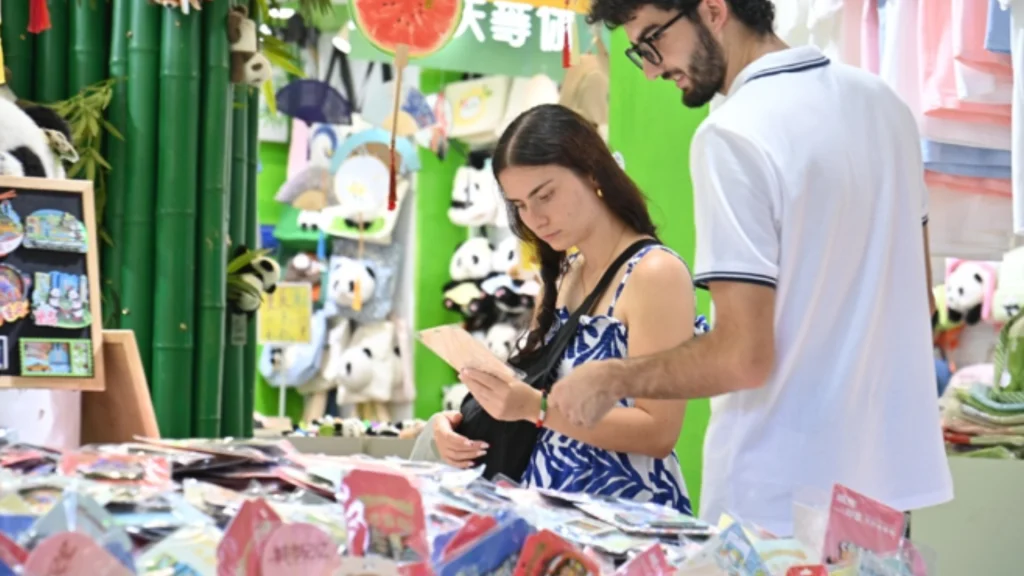
The Beijing Ancient Architecture Museum has launched a refrigerator magnet inspired by the caisson in the Heavenly Palace of Longfu Temple. Chengdu’s Kuanzhai Alley, a premier historical and cultural district, incorporates panda elements into its souvenirs. “Rong Momo,” a stuffed toy modeled on roujiamo, a well-known street food from Xi’an in northwest China’s Shaanxi province, is popular among tourists.
Culturally distinctive keepsakes have grown increasingly popular among foreign tourists in recent years. These locally designed products offer an accessible glimpse into Chinese aesthetics and cultural sensibilities.
As policies facilitating inbound tourism continue to improve, services across visa processing, border clearance, international transport, and payment have become more convenient. At the same time, immersive consumption experiences are emerging as a new highlight of “Shopping in China.”
On Guozijian Street in Beijing’s Dongcheng district, a Canadian tourist named Lillian donned traditional Chinese attire for her first travel photoshoot. “These are some of the best photos of my life,” she shared. From choosing costumes and makeup to learning traditional poses and etiquette, this experience sparked in her a strong fascination with traditional Chinese culture.
At a tax refund counter on Shanghai’s Madang Road No. 159, foreign visitors queued to complete refund procedures. Asked about their “Shopping in China” experience, many responded with a thumbs-up, describing it as “affordable, convenient, and a great overall experience.”
As the potential of “Shopping in China” continues to unfold, cities and regions across the country are moving quickly to seize the moment. By rolling out tailored policies and incentives, they aim to build a more internationalized consumption environment where foreign visitors can travel with ease and shop with greater value.
By the end of November 2025, China had 12,252 departure tax refund stores nationwide, including 9,151 newly added that year. More than 7,000 stores now offer instant refund services, with coverage continuing to expand to better meet the needs of overseas travelers.
By People’s Daily reporters




Shaping Multipolar Order: SCO Expands Strategic Role on 25th Anniversary